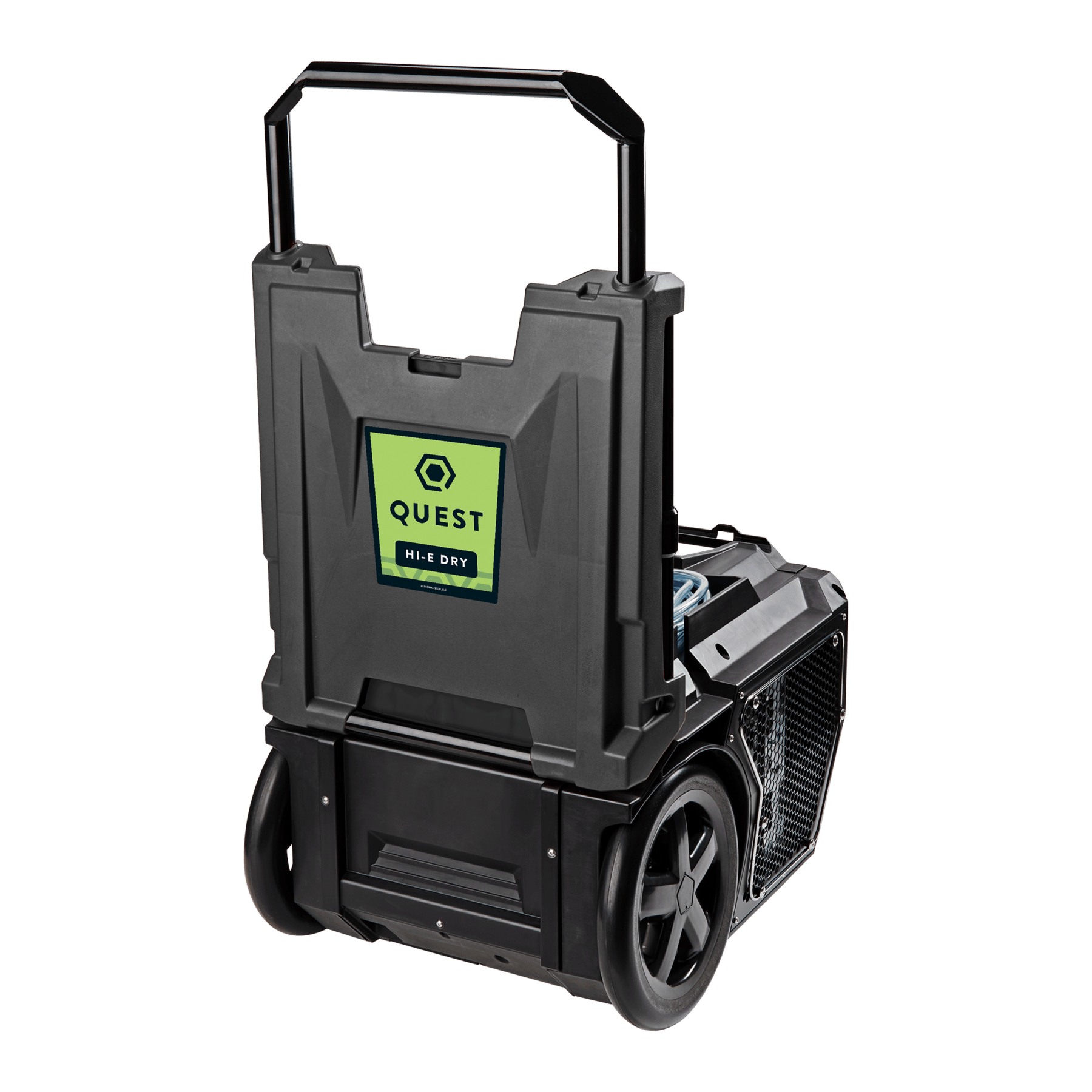
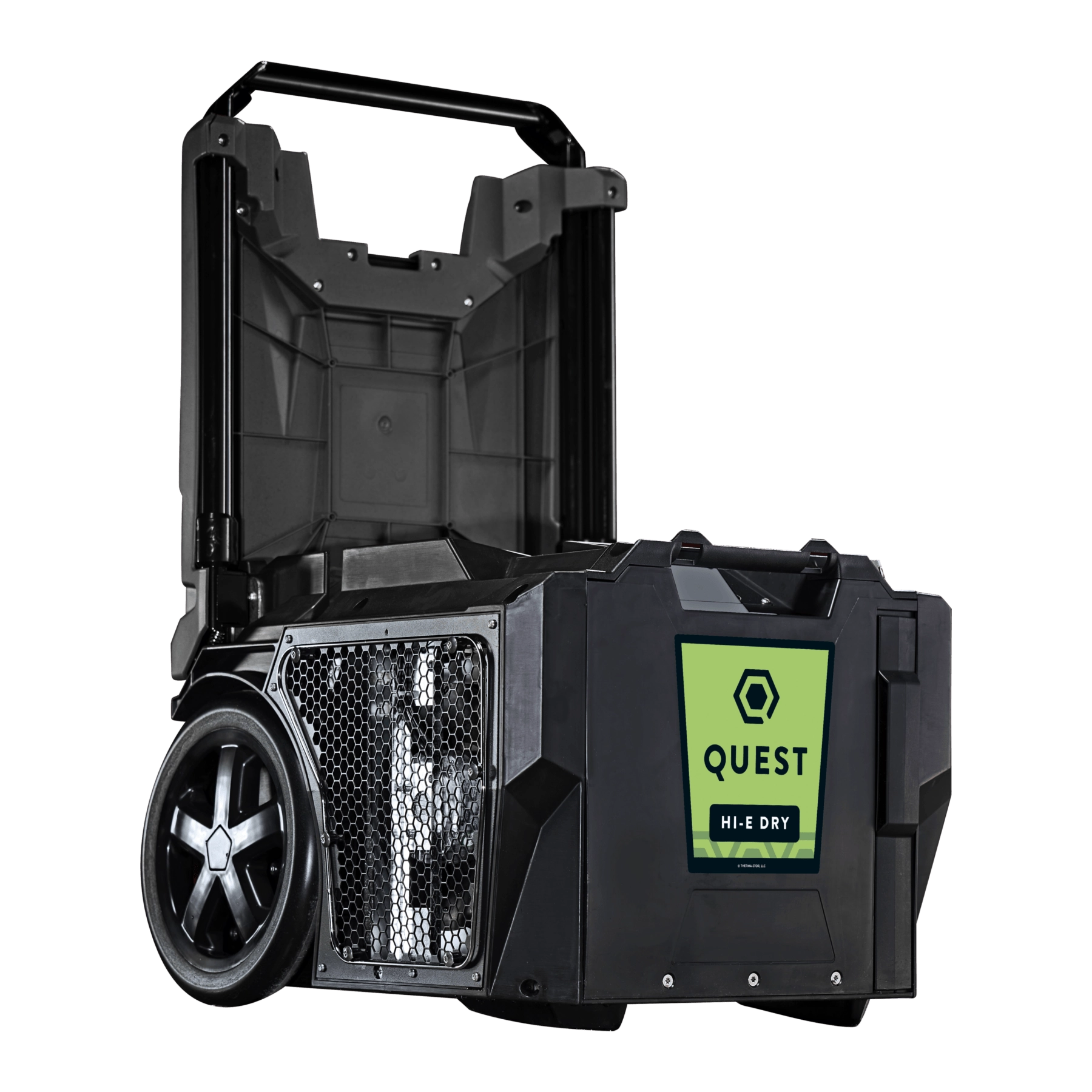
Eliminate mold and mildew, combat rust and corrosion, and increase drying and curing times with Quest’s newest HI-E DRY portable dehumidifier—the next evolution in high-efficiency, mobile moisture removal. Designed for maximum portability, this rugged, efficient dehumidifier doesn’t just perform—it moves with purpose.
Featuring 12-inch recessed wheels and a dual-position extended handle that doubles as a dolly for your F9 and F10 air movers, the HI-E Dry 140 is engineered to handle stairs and uneven surfaces with ease.
Removing 135 pints of moisture per day and an impressive 7.2 pints per kilowatt hour (@ 80 F / 60% RH conditions) this energy-efficient portable dehumidifier features a digital onboard humidistat, an internal condensate pump for up to 20 feet of easy water transport, and an extended length 25-foot power cord with mobility in mind.
Features & Benefits
Patented M-CoRR™ Technology: unique multi-coil design achieves highest efficiency available in its class
12-Inch Recessed Wheels: for superior mobility, even on stairs
Digital Onboard Control: for precise environmental control
Internal Condensate Pump: capable of lifting condensate 20 feet along with a 33-foot drain hose for extended reach
We don't have a video for this product yet. Questions? Our grow experts are here to help: 888-815-9763.
What is the Quest Hi-E Dry 140 and who is it for?
The Hi-E Dry 140 is a portable dehumidifier rated at 135 pints/day, designed to be moved room to room rather than permanently installed. It's commonly used by growers running multiple rooms as a flexible capacity boost — rolling it into whichever room needs a little extra dehumidification at a given point in the flower cycle, rather than installing a dedicated unit in every room.
Why would I use a portable unit instead of installing more permanent units?
Portables work well as a maintenance item and stopgap — if a permanent unit needs service, a portable can act as a temporary fix; and since it's stackable and foldable for storage, a couple of them in a closet can flexibly cover late-flower capacity spikes across several rooms without over-installing permanent units everywhere.
Can multiple units be daisy-chained together?
Yes. Quest units pass power through their dry contacts to the next unit in the chain. If mixing with Anden units in the same chain, the Anden units need to go first — Anden uses a true dry contact rather than passing power through.
I have about 200 of these in our building. They are solid in all kinds of conditions, including the high-humidity environments that most of them live in. In fact, I just learned that most of the employees just wash them with the power washer (they do unplug them first)! I've never had a problem with any of them, except that the departments tend to steal them from each other for their own purposes.
I'll probably come back to Hydrobuilder for more as long as the price is right! At least until I have enough that they stop stealing from each other.
This sett up is great relatively easy compared to all the other methods I've use over the last 40 years at my age simple and easy with great results is where it's at