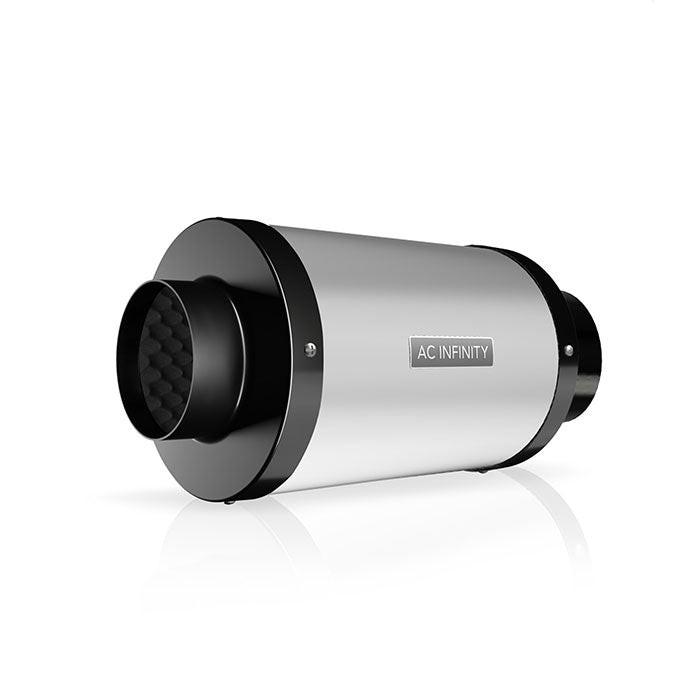
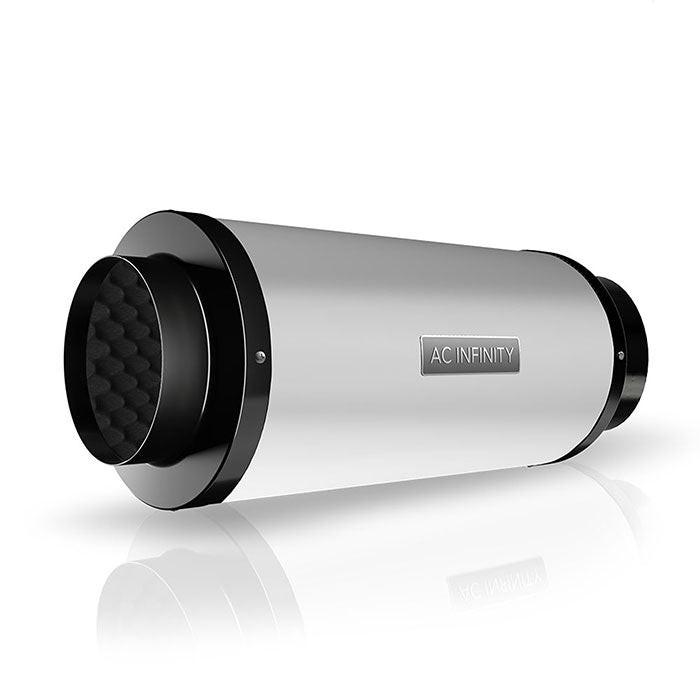
Duct Mufflers & Silencers for Grow Room Fans
Duct mufflers and silencers reduce the noise transmitted through grow room ventilation ductwork - absorbing the turbulent airflow noise generated by inline fans before it travels through the duct system and into the surrounding living space. Inline fans are inherently noisy appliances; the air turbulence at the fan housing and the pressure waves in the duct generate broadband noise that can be heard clearly in adjacent rooms. Acoustic duct silencers are passive devices - no moving parts, no power required - that line the duct interior with sound-absorbing material to reduce transmitted noise by 10-20+ dB depending on design and installation.
How Duct Silencers Work
A duct silencer (also called a sound attenuator or acoustic muffler) is a section of duct lined with dense fiberglass, mineral wool, or foam sound-absorbing material. As turbulent airflow passes through the lined section, the acoustic energy in the airflow is converted to heat through friction with the absorptive lining rather than continuing as sound waves through the duct. Standard installations use one silencer on the exhaust side and optionally one on the intake side of the inline fan. The silencer is connected inline between the fan and the carbon filter on the exhaust run, or between the fan and the tent/room intake port. Pair with quality inline fans and a fan speed controller - reducing fan speed is the single most effective noise reduction measure alongside silencer installation.
Sizing & Installation
Duct silencers are sized by duct diameter (4-inch, 6-inch, 8-inch, 10-inch) to match the fan and ductwork they connect to. Length affects attenuation - longer silencers provide more noise reduction but add to the installation footprint and slightly increase system airflow resistance. Standard grow room silencers are 18-24 inches in length, providing meaningful noise reduction without the space requirements of longer commercial attenuators. Use flexible duct connectors between the fan, silencer, and filter to decouple vibration transmission that bypasses the silencer through rigid connections. Fast shipping.
Duct Silencers FAQ
Do duct silencers actually reduce grow room fan noise?
Yes - duct silencers meaningfully reduce airborne noise transmitted through the ductwork, typically by 10-20 dB depending on the silencer design, installation quality, and fan speed. A 10 dB reduction is perceived as approximately halving the loudness. However, silencers only address duct-transmitted airborne noise - fan vibration transmitted through rigid duct connections or mounting hardware bypasses the silencer entirely. Use flexible duct couplings on both sides of the fan and silencer, and avoid hard-mounting the fan directly to rigid structures, for the best combined result.
Where do I install a duct silencer?
The most effective position is on the exhaust side of the inline fan, between the fan outlet and the carbon filter or exhaust duct run. This location treats the highest-turbulence section of the airflow path where most duct noise originates. A second silencer on the intake side (between the tent intake port and the fan inlet) further reduces noise for setups where intake noise is also a concern. Connect with flexible duct couplings on both sides of the silencer rather than rigid duct connections, to prevent vibration bypassing the silencer.
What is the difference between a duct silencer and acoustic ducting?
Duct silencers are discrete components installed inline that absorb noise from the airflow passing through them. Acoustic (insulated) ducting is flexible duct with a sound-absorbing layer built into the duct wall that reduces noise transmission through the duct walls along the full length of the run. Both reduce noise but through different mechanisms. Acoustic ducting addresses noise radiated through the duct walls along the run; silencers address noise traveling through the airflow itself. For maximum noise reduction, use both - acoustic flex duct for the runs with a silencer at the fan connection point.
What size duct silencer do I need?
Match the silencer diameter to your fan and ductwork diameter - the most common grow room sizes are 4-inch and 6-inch. Using a different diameter requires reducers that increase airflow restriction without improving noise reduction. For length: longer silencers provide more attenuation - a 24-inch silencer reduces noise more than an 18-inch unit of the same diameter. If space allows, choose the longer option. Standard 4-inch and 6-inch silencers in 18-24 inch lengths address most hobby and small commercial grow room noise concerns at a reasonable space footprint.
Will a duct silencer reduce airflow?
All duct components add some airflow resistance. A properly sized duct silencer adds modest static pressure resistance - typically 0.1-0.3 inches of water column at typical grow room airflow rates. This is manageable for most quality inline fans without significant CFM reduction at normal operating speeds. To compensate for the added resistance, use a fan rated for slightly higher CFM than the bare minimum for your space, or run the fan at a somewhat higher speed setting. Do not use undersized silencers (smaller diameter than your ductwork) as the restriction from the reducer fittings will be more significant than the silencer itself.