
Picked up a used Twister T6 for $400 and replaced the gear box for $100 and now its like new again.

Your System
Pick your options and your system will assemble here as you build it.
Related Reading
Unlocking Optimal Nutrient Delivery with Dosatron
Check out the Nutrient Delivery System developed hydroponic growing operations.
The Nutrient Delivery System is a simple system made up of four main panel sections which can be arranged to accommodate a wide variety of fertigation programs. With total control in mind, customizing the entire panel is easy based on your personal nutrient program!
The Nutrient Delivery System thrives anywhere, from greenhouse environments to outdoors, allowing it to be installed in any application. By automating the nutrient delivery process it accurately dispenses the desired solution. This makes the time-draining practice of “measure and pour” a thing of the past, saving you time and money!

Nutrient Delivery System Benefits
ACCURATE: Used to accurately fill reservoirs or in a drain to waste system — eliminating the need to measure and pour.
EASY: Easy to adjust the amount of nutrient being dispensed — simply turn the dial to set the necessary dosage rate. Simple and inexpensive to maintain — easy to use!
VERSATILE: Designed to perform in both indoor and outdoor environments. Now that’s awesome!
PRECISE: Precise nutrient management will save you money by eliminating waste and increasing yields.
Creating the right nutrient mix for your hydroponic growing operations is a delicate science. With Dosatron’s full line of injectors, you can automate your process to create fine-tuned, multi-chemical mixes with repeatable results, every time! They are water-powered so no electricity is needed and compared to other dosing products on the market, they are easy to maintain and keep in service — saving you time and money.
The Nutrient Delivery System Injectors
Dosatron injectors use volumetric proportioning, meaning they maintain the same chemical-to-water ratio no matter the water flow rate. This ensures consistent results in every application.
How Does It Work?
- Water Flow Activation: As water enters the injector, it powers the hydraulic motor, eliminating the need for electricity.
- Proportional Chemical Injection: On the upstroke, the injector draws the precise amount of concentrate from the chemical tank, similar to a hypodermic syringe. On the downstroke, the concentrate is injected into the mixing chamber.
- Thorough Mixing: The chemical blends seamlessly with the water inside the injector before being discharged.
- Consistent and Reliable Output: The fully mixed solution is delivered into the water line at the exact ratio set by the user, ensuring repeatable and accurate dosing every time.
D14 Series
14 GPM

D6 Series
26 GPM

D40 Series
40 GPM

| Specification | D14 Series | D6 Series | D40 Series |
|---|---|---|---|
| Connection Size | 3/4" NPT | 1 1/4" NPT | 1 1/2" NPT |
| Unit Weight | 6 lbs | 9 lbs | 12 lbs |
| Dimensions | 19 1/18" x 6 5/16" | 24" x 9" x 8" | 25 1/4" x 8 1/2" |
| Flow | 0.05 to 14 GPM (0.19 to 50 LPM) | 0.44 to 26 GPM (1.66 to 98 LPM) | 2.2 to 40 GPM (8.32 to 151 LPM) |
| Pressure | 4.3 to 85 PSI | 4.3 to 116 PSI | 4.3 to 116 PSI |
Dosatron System Example using HGV Nutrients
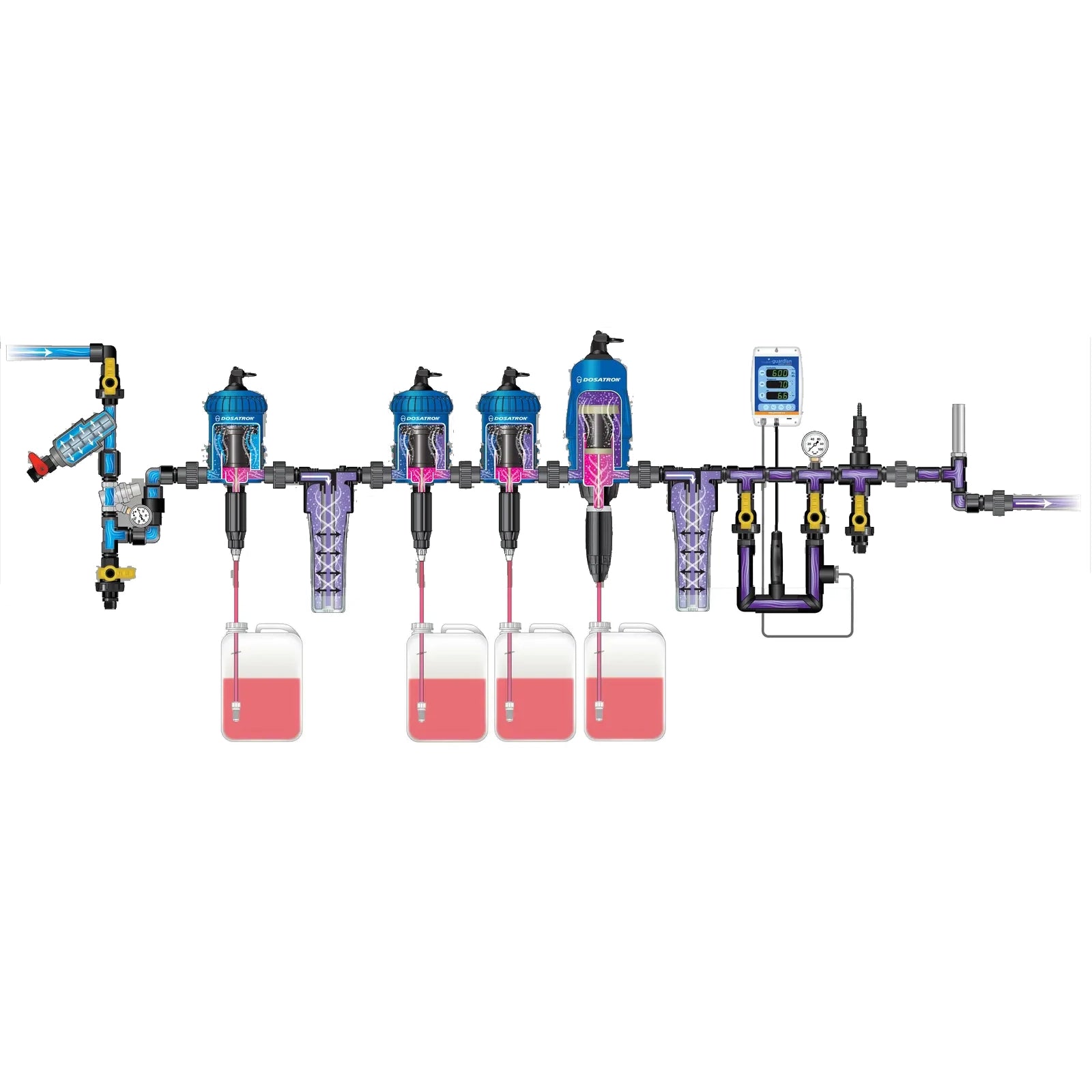
This is an example of the Dosatron Nutrient Delivery System configured for Hi-Flo with the D40 Series and HGV Liquid Nutrients. Starting from left to right the system is comprised of the following; the Hi-Flo Starter Kit, (x1) D40MZ3000 Injector (VF), (x2) D40MZ2 Injector (VF), (x1) D40MZ2 Injector (AF), (x3) Hi-Flo Mixing Chambers, (x1) Hi-Flo Monitor Kit, (x1) Hi-FLo Water Hammer Arrestor Kit.
The D40MZ3000 and the first 2 D40MZ2's are configured with Viton Seals. The last D40MZ2 is configured with Aflas seals to accomadate the higher pH value chemistries. Below is a comparison table highlighting when to use which type of seal.

| Dosing Seals | Recommended For | Part Number |
|---|---|---|
| AF (Aflas) | Caustic/higher pH value (7.0 and higher) chemistries | D40MZ - BPAFHY |
| VF (Viton) | Acidic/lower pH value (7.0 and lower) chemistries | D40MZ - BPVFHY |
| K (Kalrez) | Concentrated acids and strong oxidizers such as peracetic acid | D40MZ - BPVFHYK |
Dosatron: How Do Dosatron Injectors Work?
Discover Dosatron: Your Gateway to Precision Nutrient Delivery Systems
How do I calculate the right flow rate for a Dosatron injector?
Multiply the number of emitters by their GPH rating, then divide by 60 to convert to GPM. For example, 1,000 emitters at 0.5 GPH = 500 GPH ÷ 60 = 8.3 GPM. Select a Dosatron model whose rated operating range includes that flow and ideally provides some headroom above it. Always size to your largest active zone, not your total system capacity.
For zoned systems, your design number is the flow demand of the single largest zone running simultaneously — not the cumulative total of all zones. Running a 14 GPM unit around 8.3 GPM gives it accurate operating headroom; regularly running it at 13.9 GPM pushes it near its ceiling, which can degrade precision and accelerate wear over time. Commercial operations with separate zone headers may prefer per-zone injectors rather than a single oversized unit on the main if they need different recipes or more redundancy.
Commercial application: Warehouse and greenhouse operations above roughly 20 GPM peak per active header should evaluate the D6MZ2 (26 GPM), D40MZ (40 GPM), or 100 GPM D20/D100 series depending on zone architecture and mainline sizing.
What is the injection ratio on a Dosatron and how do I know which one I need?
The injection ratio tells you how much concentrate mixes into the water. A 1:100 ratio delivers 1 part concentrate per 100 parts water (1%); a 1:3000 ratio delivers 1 part per 3,000 parts (0.033%). Your nutrient manufacturer's Dosatron or injector mixing guide specifies the target ratio for their recommended stock solution concentration, usually tied to target EC at the emitter.
Standard liquid nutrients typically use an MZ2 unit (1:500 to 1:50 range). Concentrated dry nutrient programs — particularly those mixed at high stock solution strength — often require MZ1000 (1:1000 to 1:100) or MZ3000 (1:3000 to 1:333) units to achieve the correct delivered EC without unmanageable stock volumes. When your target ratio falls near the boundary of two ranges, choose the unit whose range centers on your target rather than one where your ratio sits at the extreme end, which gives you more usable adjustment and stability.
Commercial application: Two-part dry programs at commercial scale (HGV, Athena Pro) often use matched-ratio injectors per part to maintain independent EC control over A and B stock tanks, then fine-tune the panel based on inline EC readings as described in manufacturer best-practice videos and guides.
What is the difference between Viton, Aflas, and Kalrez seals in a Dosatron?
The three seal materials determine chemical compatibility. Viton fluoroelastomer seals handle most fertilizers, many pesticides, and a range of mineral acids and pH-down products in the neutral-to-acidic range when used within the manufacturer's limits. Aflas is designed for alkaline chemistry — pH up products, calcium hydroxide suspensions, and potassium carbonate-based buffers — and is used where Viton would have reduced life due to strong bases. Kalrez perfluoroelastomer seals are specified for aggressive oxidizers like peracetic acid (PAA) sanitizers such as BioSafe ZeroTol or SaniDate, where other elastomers would degrade quickly.
Using the wrong seal accelerates wear, reduces injection accuracy, and can cause premature failure or leakage, particularly in high-cycle commercial systems. If you're injecting more than one solution type, the rule is simple: each incompatible chemistry gets its own Dosatron with the appropriate seal documented for that chemical. Many commercial operations run a Viton nutrient injector, an Aflas pH correction injector, and a Kalrez sanitation injector in series for precisely this reason.
Commercial application: Sanitation injectors with Kalrez seals should typically be installed as the final unit in a series configuration, downstream of nutrient and pH injectors, in line with standard hygiene and materials compatibility practices.
Can I use a Dosatron for pH adjustment, not just nutrients?
Yes. Dosatron units are commonly used to inject pH correction solutions inline — but the seal material and ratio range must match the chemistry and the concentration you plan to run. Phosphoric acid or citric acid pH-down products are usually compatible with Viton-sealed units within specified concentration limits. Potassium hydroxide pH-up products, on the other hand, are matched to Aflas seals in Dosatron's documentation. Injecting a strong pH-up solution through a Viton-sealed unit can degrade the seals significantly faster than intended.
For separate pH correction injection, a low-volume secondary injector positioned downstream of the nutrient injector is the standard commercial configuration. This keeps pH chemistry separate from nutrient stock tanks and allows independent ratio adjustment, helping you dial in both EC and pH at the header or inline meter.
Commercial application: Two-part acidification systems using both acid A and pH correction, or systems that combine alkalinity control with fertigation, typically use two separate injectors with appropriate seal selection for each solution to avoid cross-contamination and premature wear.
What is a Lo-Flo Dosatron system and when do I need one?
The Lo-Flo system is Dosatron's platform for highly concentrated dry nutrient programs and other applications that require very low injection volumes per gallon of water. Standard injectors are optimized for liquid nutrients at moderate concentration; when you're injecting highly concentrated dry nutrient stock at ratios toward the upper end of ranges like 1:3000, the Lo-Flo mixing chamber and low-flow doser can deliver better accuracy at those micro-volumes by operating in a more favorable part of their range.
Lo-Flo is most appropriate for operations running concentrated A/B dry programs — including Organics Alive and similar commercial dry lines — where stock solution concentration exceeds what standard injectors handle cleanly while staying within comfortable ratio settings. The pre-configured Lo-Flo bundle for Organics Alive nutrients on HydroBuilder is a turnkey option for those programs, and its design principles are similar to what high-density cannabis and CEA facilities often deploy around concentrated dry lines like Athena Pro or HGV.
Commercial application: Large multi-room operations running dry programs at uniform concentration throughout all zones benefit most from Lo-Flo systems, as consistent injection accuracy at low dosing volumes becomes more critical at scale and across many irrigations per day.
Do Dosatron injectors work without electricity?
Yes — that's a core design feature. Dosatron units are water-powered proportional dosers. Water pressure drives an internal piston that draws concentrate from the stock tank and mixes it proportionally to water flow volume, not directly to water pressure alone, as long as flow and pressure remain within the injector's specified range. This means injection accuracy is maintained across reasonable fluctuations in line pressure and is not affected by power outages to the facility, since no external power is required for the injector to operate.
Because there are no electrical components in the injector itself, Dosatron units are suitable for wet environments, are generally simpler with respect to electrical code requirements than powered injection equipment, and require no electrical installation for the injector body. This is one reason they are widely adopted in greenhouse, nursery, livestock, and cannabis cultivation applications worldwide.
Commercial application: Water-powered operation simplifies permitting for new facility builds and can reduce both initial installation cost and long-term electrical maintenance overhead compared to powered dosing pumps, especially when multiple injection points are required.
How many Dosatron injectors do I need for a two-part nutrient program?
Most two-part liquid programs that are designed to be mixed together at stock strength can be premixed in a single stock tank and injected through one Dosatron, if the nutrient manufacturer explicitly approves that approach. However, for dry nutrient programs or any two-part system where Part A and Part B would precipitate if combined in concentrated form, you need two separate injectors: one per part, configured in series on the same water line.
Each injector has its own stock tank and operates independently, so there is no interaction between concentrates until they meet the diluted water stream downstream of both injectors. This is the standard configuration for HGV, Athena Pro, and General Hydroponics FloraPro dry programs, as shown in manufacturer injector-panel guidance.
Commercial application: Series dual-injector builds with matched ratio units are standard practice in commercial cannabis. Adding a third Kalrez-sealed injector for PAA sanitation creates a three-stage inline fertigation system that handles nutrients, pH or alkalinity adjustment, and sanitation from a single water main while keeping chemistries separated until the distribution line.
Are there pre-configured Dosatron kits for specific nutrient brands?
Yes. HydroBuilder offers complete pre-built Dosatron systems matched to HGV, Athena, and Botanicare nutrient programs, among others, via dedicated bundles. These bundles include the injector model with the correct ratio range for the nutrient line's stock solution requirements, a mixing chamber or similar blending hardware where applicable, and plumbing components — which greatly reduces the need to independently verify every detail of injector-to-nutrient compatibility for a first-time installation.
For growers who aren't yet committed to a nutrient brand, the Dosatron Starter Kit provides a complete hardware system in a brand-agnostic configuration. Pre-configured kits are particularly valuable for first-time Dosatron installations because they remove one of the most common sources of setup error: mismatched injection ratio to stock concentration or seal type to chemistry.
Commercial application: Multi-room commercial builds often standardize on a single nutrient brand bundle or a small set of bundles to simplify inventory management for maintenance kits and replacement parts, and to keep injector settings consistent across facilities or rooms.