Jacketed Reactors & Glass Reactor Vessels
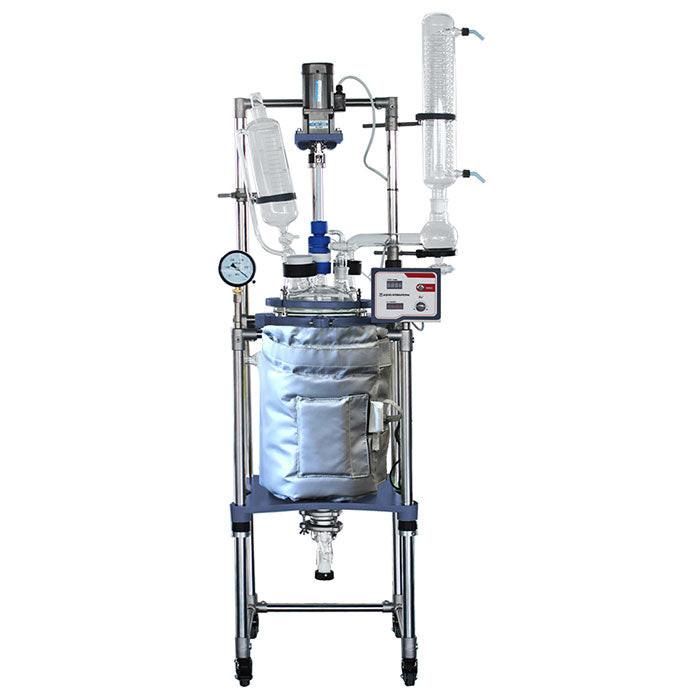
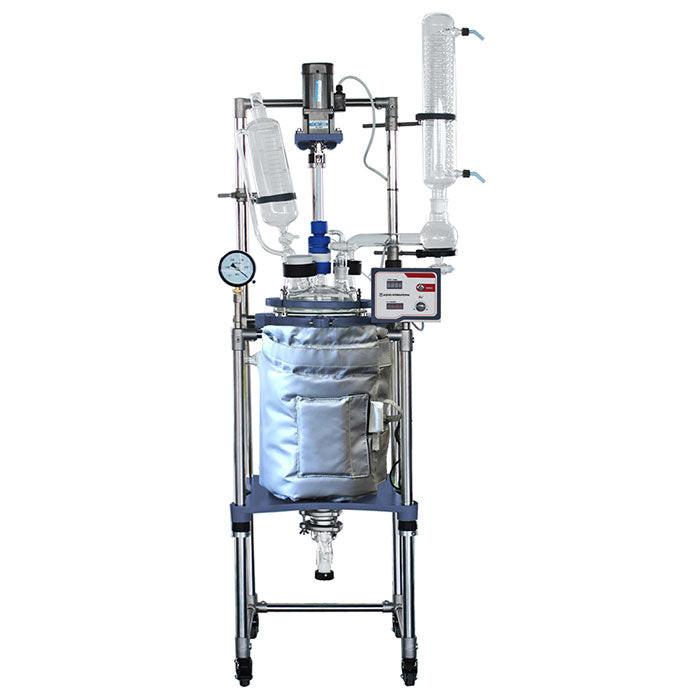
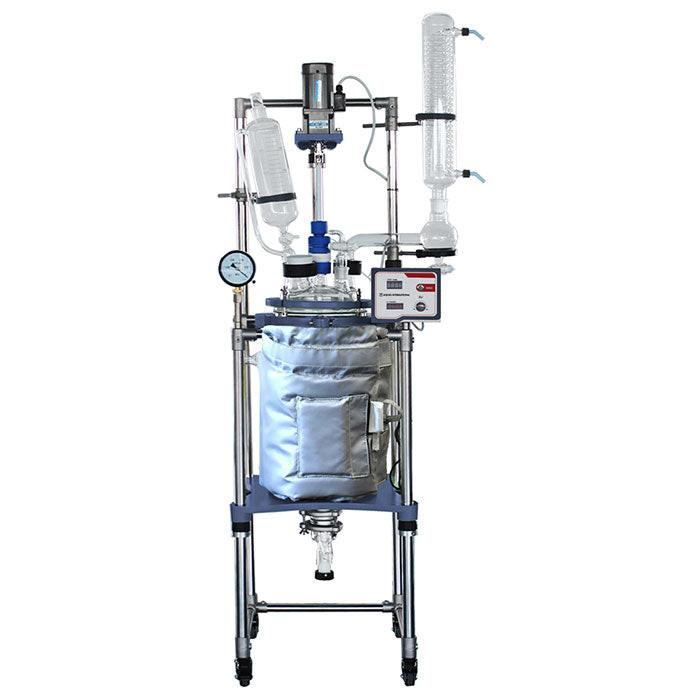
Jacketed reactors are double-walled glass or stainless steel vessels where a heat-transfer fluid circulates through the outer jacket to precisely control the temperature of the reaction or process contents inside the inner vessel. The jacketed design provides highly uniform temperature control - heating, cooling, or maintaining a setpoint - without direct contact between the heat source and the process contents, eliminating the localized hot spots and thermal gradients of heating mantle or oil bath approaches. In botanical extraction processing, jacketed reactors are used for solvent recovery, winterization, controlled heating of large batches, and other processes where precise temperature control of a large volume is critical.
Reactor Components & Integration
A complete jacketed reactor setup requires: the reactor vessel (with jacket ports for fluid inlet/outlet, a stirring port, and access ports for addition and measurement), a recirculating chiller or heater/chiller unit to pump temperature-controlled fluid through the jacket, a mechanical overhead stirrer for mixing vessel contents, a vacuum connection for reduced-pressure operations, and supporting clampware and stands. Most glass jacketed reactors use borosilicate glass with standard 24/40 or 29/42 taper joints for port fittings; stainless steel reactors use sanitary tri-clamp fittings. Glass reactors allow visual monitoring of the process; stainless steel reactors offer greater pressure and impact resistance for more demanding applications.
Working Volume & Scale
Glass jacketed reactors for laboratory and small commercial extraction use are available in volumes from 1 liter through 100 liters. Match reactor volume to the batch size of the process - filling the reactor to 50-70% of its total volume is optimal for stirring and vapor space. For operations scaling beyond 100-liter single-vessel processing, custom or pilot-scale stainless steel jacketed reactors are the standard. Expert support available - call 888-815-9763 for sizing guidance on commercial extraction setups. Fast shipping.
Jacketed Reactors FAQ
What is a jacketed reactor used for in botanical processing?
In botanical extract processing, jacketed reactors are used for: solvent recovery (concentrating an extract by evaporating solvent under vacuum with precise temperature control); winterization (precipitating waxes and lipids by cooling a dissolved extract to very low temperatures while stirring, then filtering); controlled heating of large batches (heating a crude extract to the target temperature uniformly without hot spots); and liquid-liquid separation processes. The jacketed design allows both heating and cooling from the same vessel, making it versatile across multiple processing steps that require different temperatures.
What is the difference between a single-jacket and double-jacket reactor?
A single-jacketed reactor has one jacket layer surrounding the inner vessel - heat-transfer fluid passes through this single jacket to control vessel temperature. A double-jacketed reactor has two concentric jacket layers - the inner jacket carries the heat-transfer fluid and the outer jacket provides insulation, improving temperature uniformity and reducing heat loss to the environment. For most botanical processing applications, a single-jacketed reactor with a good recirculating chiller/heater provides adequate temperature control. Double-jacketed reactors are used when very precise temperature uniformity is critical or when the process requires maintaining very low temperatures where insulation significantly affects performance.
What chiller do I need for a jacketed reactor?
The chiller must match the reactor jacket volume and your target temperature range. Key specifications: (1) Cooling capacity in watts at your minimum target temperature - cooling capacity decreases significantly at very low temperatures, so verify the chiller's rated capacity at the actual operating temperature, not just at room temperature; (2) Flow rate - sufficient pump flow to circulate heat-transfer fluid through the reactor jacket; (3) Working temperature range - verify the chiller reaches your minimum required temperature (winterization to -20 degrees C or lower requires a chiller rated for that range). Use silicone or propylene glycol/water mixtures as the heat-transfer fluid for most botanical processing temperature ranges.
Can I use a jacketed reactor for ethanol extraction?
Yes - jacketed glass reactors are commonly used in ethanol extraction workflows for solvent recovery after extraction. The extract-solvent mixture is loaded into the reactor, a vacuum is applied to reduce the ethanol boiling point, and the jacket circulates heated fluid to drive ethanol evaporation. The evaporated ethanol is condensed and recovered in a separate receiving vessel. This closed-loop solvent recovery approach recovers the majority of the ethanol for reuse while concentrating the extract in the reactor vessel. Ensure all electrical equipment in the vicinity is rated for use in the presence of flammable solvent vapors when running ethanol recovery.
What size jacketed reactor do I need?
Fill the reactor to 50-70% of total vessel volume for optimal stirring and adequate vapor space above the liquid surface. For a process batch of 5 liters of extract solution: a 10-liter reactor (50% fill) or 7-liter reactor (70% fill) is appropriate. Scale accordingly - avoid operating reactors above 70% fill or the stirrer will not mix effectively and vapor space will be insufficient for evaporative operations. Standard glass reactor sizes: 2L, 5L, 10L, 20L, 50L, 100L. For most small commercial botanical processing applications, 5-50 liter glass jacketed reactors cover the relevant batch size range.