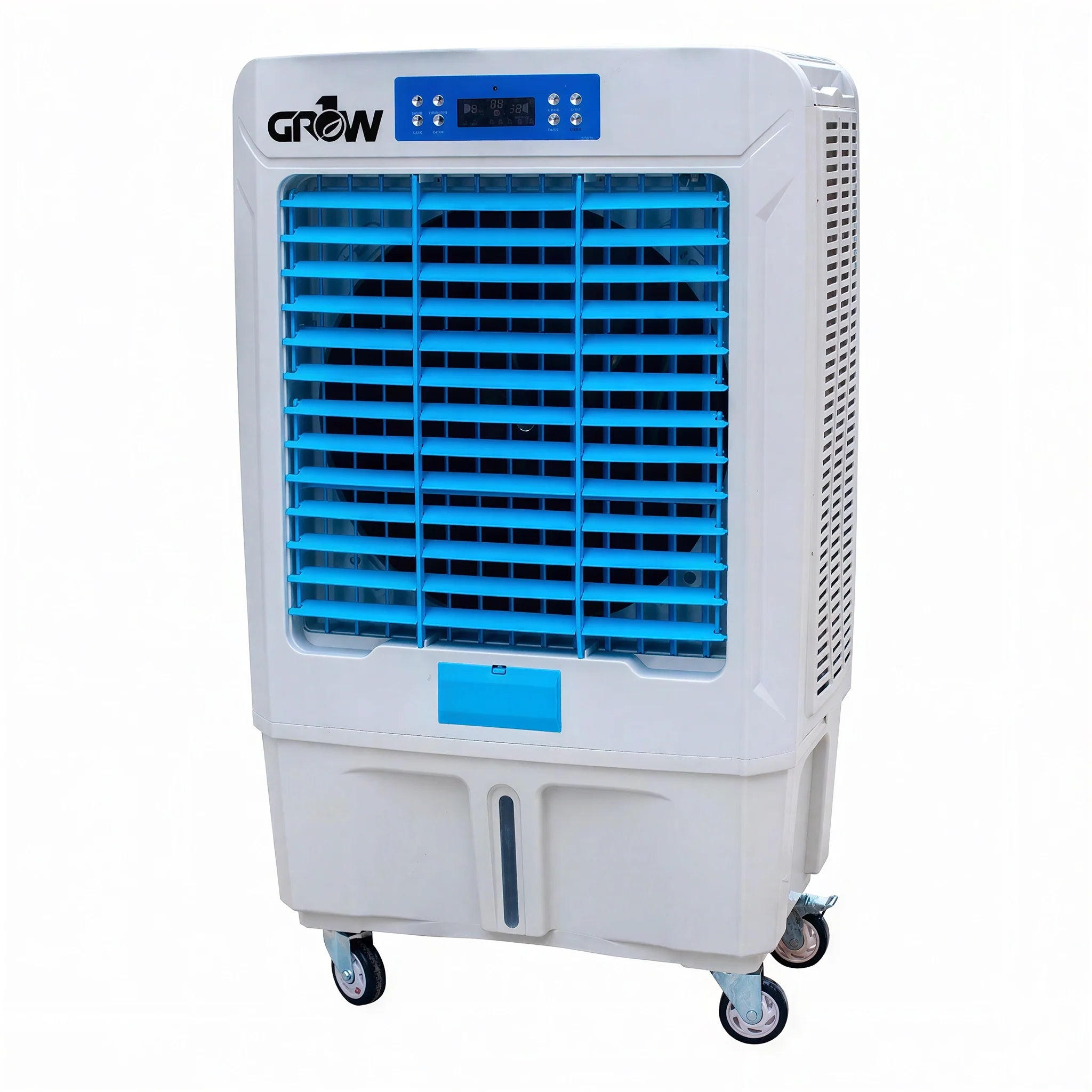
Evaporative Coolers & Swamp Coolers for Growing
Evaporative coolers (swamp coolers) cool air through the evaporation of water - hot, dry air passes through water-saturated cooling pads, and as the water evaporates it absorbs heat from the air, lowering the air temperature by 10-30 degrees F depending on the ambient relative humidity. Evaporative cooling is highly effective in hot, dry climates (below 50% RH) where the air has capacity to absorb significant additional moisture during the cooling process. In high-humidity environments, evaporative cooling loses effectiveness rapidly - when ambient humidity approaches saturation, little additional evaporation occurs and temperature drop is minimal.
When Evaporative Cooling Works for Growing
Evaporative coolers are well-suited for greenhouse and outdoor growing structure pre-cooling in dry-climate regions - the Southwest US, high desert areas, and similar low-humidity climates where summer heat regularly exceeds plant tolerance. In these environments, an evaporative cooler can maintain a greenhouse 15-25 degrees F cooler than ambient with very low energy consumption compared to refrigerant-based cooling. For sealed indoor growing rooms where humidity is already managed, evaporative coolers add moisture to the air and can push RH above the range needed for the plants - they are not appropriate for humidity-sensitive flowering programs in enclosed rooms. The humidity addition is a feature in propagation environments and a limitation in flowering environments.
Ducted vs. Portable Configurations
Ducted evaporative coolers mount on the roof or wall of a structure and distribute cooled air through ductwork or direct air delivery ports - the standard for greenhouse and large structure cooling. Portable evaporative coolers (personal or room-scale) are self-contained units that draw in warm dry air, cool it through internal water-saturated pads, and discharge cooled air directly - suitable for spot cooling in dry climates and for propagation humidity in any environment. Browse our grow room air conditioning collection for refrigerant-based cooling alternatives when evaporative cooling is not appropriate for your climate or humidity conditions. Fast shipping.
Evaporative Coolers FAQ
How much can an evaporative cooler lower the temperature?
Temperature reduction depends almost entirely on the ambient relative humidity. At 10% RH: 20-30 degree F drop is achievable. At 30% RH: 15-20 degree F drop. At 50% RH: 5-10 degree F drop. At 70%+ RH: minimal cooling effect - the air is already near saturation and cannot absorb much additional moisture. The wet bulb depression (difference between dry bulb temperature and wet bulb temperature) is the physical limit of evaporative cooling performance in any given condition. Check your local average summer RH before committing to evaporative cooling - it is highly effective in dry climates and nearly ineffective in humid climates.
Can I use a swamp cooler in my indoor grow room?
Evaporative coolers are not recommended for sealed indoor growing rooms during flowering because they continuously add moisture to the air, raising RH beyond the levels that flowering plants need (50-60% RH). In a sealed room with no humidity exhaust, RH will climb toward saturation as the cooler operates, creating conditions favorable to botrytis and other moisture-related diseases. For sealed indoor growing rooms, refrigerant-based cooling (mini-split, portable AC) is the correct approach. Evaporative coolers work well in indoor growing rooms in very dry climates where humidity also needs to be raised, or in open greenhouses where moisture can escape.
How much water does an evaporative cooler use?
Evaporative coolers consume water continuously during operation - the evaporated water is the cooling mechanism. Typical consumption: residential portable units use 1-3 gallons per hour; roof-mounted whole-greenhouse units use 3-10+ gallons per hour depending on capacity and operating conditions. All consumed water must be supplied continuously - connect to a water supply line with a float valve (most ducted coolers) or refill manually for portable units. Water quality matters: high-mineral hard water deposits scale on the cooling pads that reduces performance and requires more frequent pad replacement or cleaning.
How do I maintain evaporative cooler pads?
Cooling pads (typically cellulose or synthetic evaporative media) accumulate mineral deposits from water evaporation and organic debris from air filtration. Inspect pads monthly in season: rinse with clean water to remove loose debris; treat mineral scale with dilute citric acid solution. Replace pads when they have calcified significantly, show mold growth, or have developed air bypass channels from pad shrinkage. Most residential and commercial evaporative cooler pads last 1-3 seasons depending on water quality and operating hours. At season end, drain and dry the system completely to prevent mold growth in standing water over the off-season.
What is the difference between a direct evaporative cooler and an indirect evaporative cooler?
Direct evaporative coolers (standard swamp coolers) pass air directly through wet pads - the cooled air picks up moisture from the pads and enters the conditioned space at higher humidity. Indirect evaporative coolers use a heat exchanger to cool a secondary air stream with evaporation on one side without adding moisture to the delivered air on the other side - producing cool, dry air rather than cool, humid air. Indirect evaporative coolers are more complex and expensive but avoid the humidity addition that makes direct coolers problematic for high-humidity-sensitive crops. True indirect units are uncommon in growing applications; most "two-stage" evaporative coolers combine an indirect stage with a direct stage for improved efficiency.