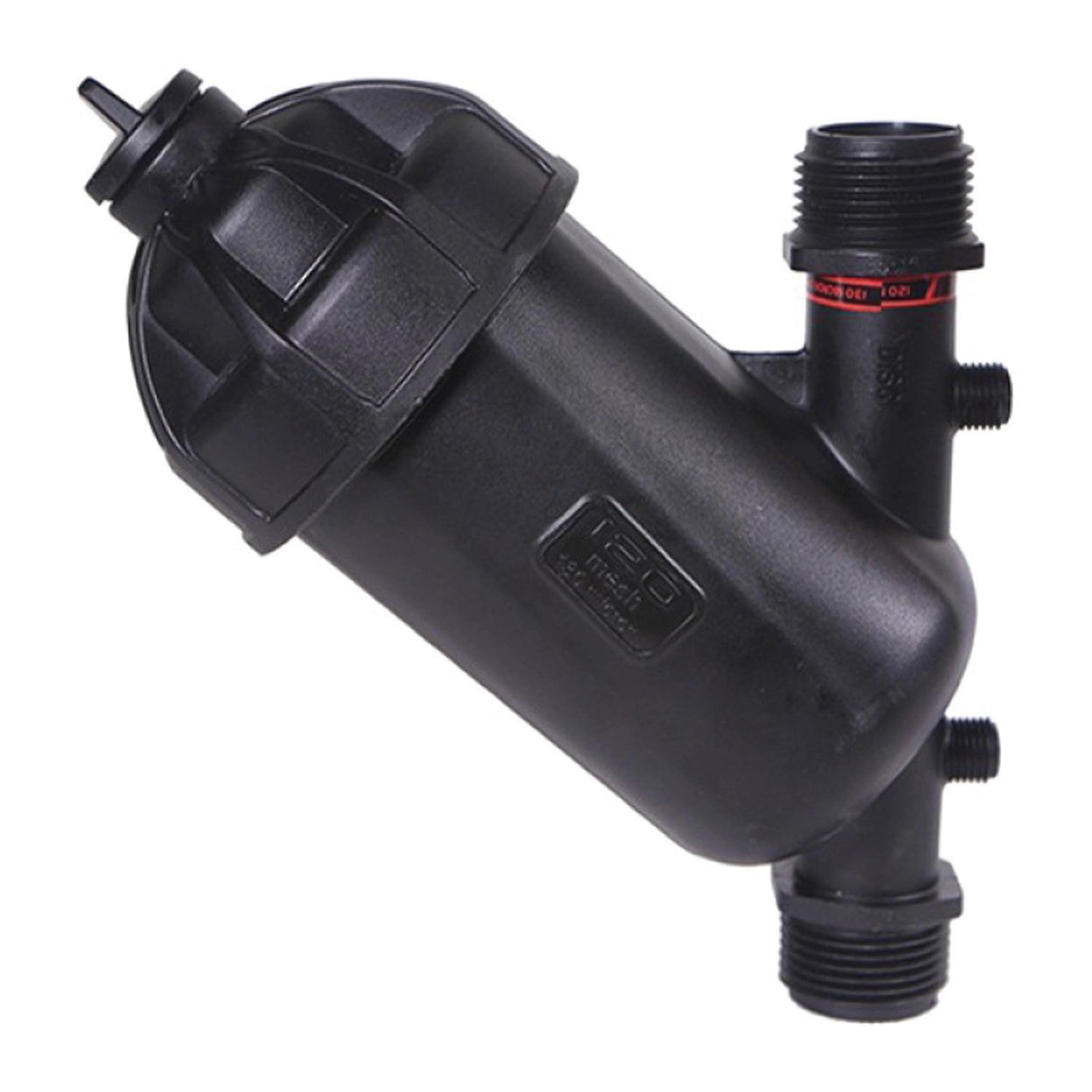
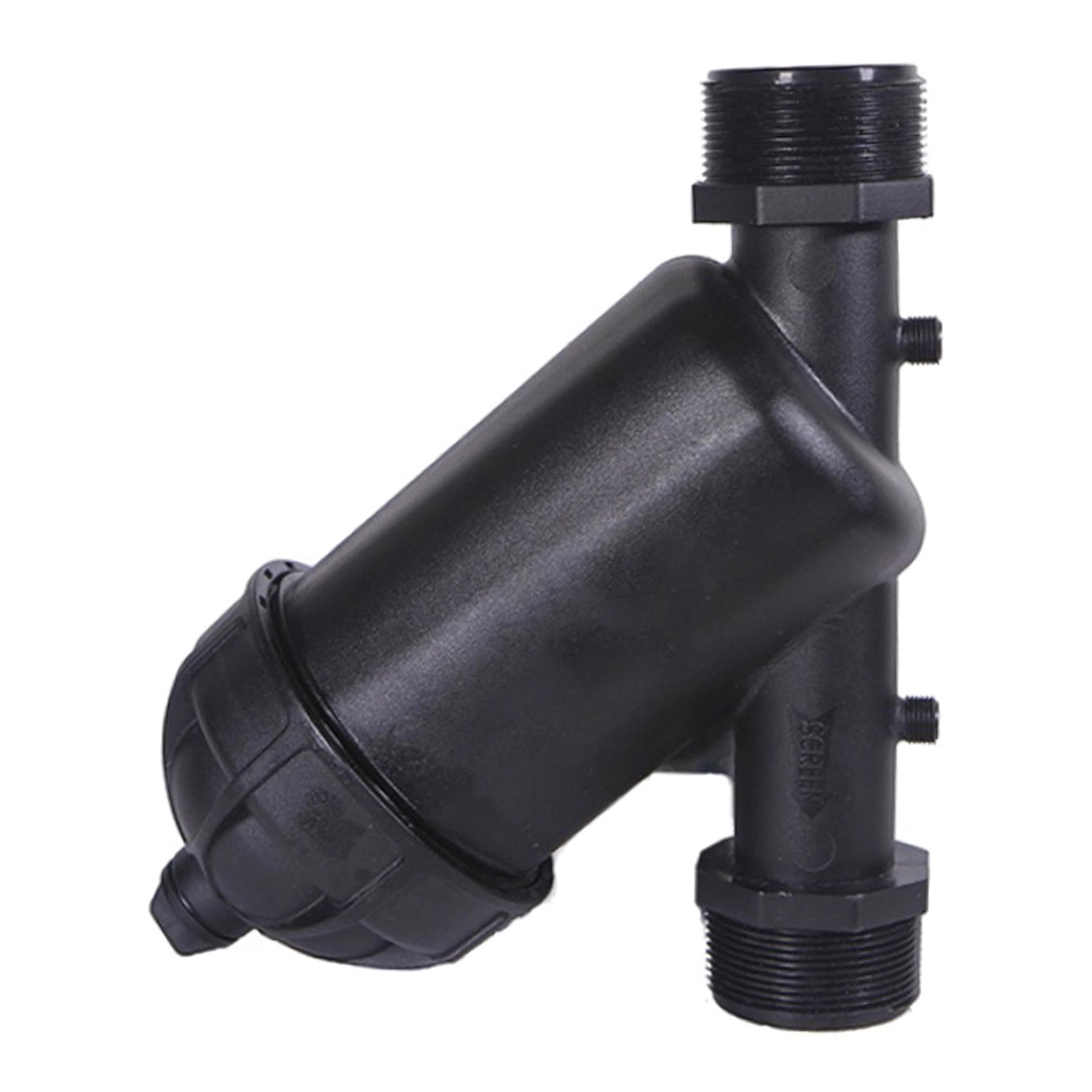
Drip Irrigation Filters & Screen Filters
Drip irrigation filters are the single most important component for long-term drip system reliability -- they remove the sediment, organic particles, and debris that would otherwise clog the small flow paths of drip emitters, dripline emitters, and pressure regulators. A clogged emitter delivers less water than its neighbors, creating inconsistent irrigation that affects plant growth and substrate moisture uniformity. A filter upstream of the emitters prevents clogging before it occurs, maintaining consistent delivery across the full system for the season. Every drip system should include a filter -- no exceptions.
Filter Types
Y-strainer screen filters are the simplest format -- also compatible with all emitter types -- a cylindrical mesh screen inside a Y-shaped housing that catches particles above the mesh opening size. Easy to service (unscrew the end cap, remove and rinse the screen), low cost, and effective for most indoor growing reservoir water. Disc filters use a stack of grooved plastic discs that filter particles in a tortuous path -- they filter more finely than equivalent screen filters, handle higher flow rates with lower pressure drop, and self-clean more effectively when backflushed. For commercial production where filter maintenance must be minimal, disc filters are the premium option. Install filters after the supply pump and before the pressure regulator in the system order.
Mesh Rating & Maintenance
Filter mesh is specified in mesh count (number of openings per inch) or microns. For standard drip emitters with 0.5-1.5mm flow paths: 80-200 mesh (75-200 micron) provides adequate filtration. For micro-drip and precision emitters with smaller flow paths: 120-200 mesh. Check and clean filters every 2-4 weeks in production -- more often if using organic nutrient solutions that promote biofilm growth, or more frequently with turbid water. A partially clogged filter reduces flow to all downstream emitters simultaneously -- a common cause of "all emitters underperforming" that is often misdiagnosed as pump failure. Fast shipping.
Drip Irrigation Filters FAQ
Why does every drip system need a filter?
Drip emitters have very small internal flow paths (0.5-2mm) that are easily blocked by particles that are invisible in the bulk water supply -- particles that pass freely through supply lines and reservoirs but are large enough to lodge in emitter orifices. Even clean-looking nutrient solution contains mineral precipitates, organic particles, and algae fragments that accumulate in emitters over time without a filter. A single clogged emitter in a commercial system may cost a plant; a batch of clogged emitters costs a section of the room. A $15-30 inline filter prevents this entire category of problem.
What mesh size filter do I need for drip emitters?
80-155 mesh (100-180 micron) is the standard for most drip emitter applications -- fine enough to catch the particles that clog standard emitter flow paths, without restricting flow enough to cause significant pressure drop at typical system flow rates. For very fine emitters or micro-irrigation systems with smaller flow paths: 200 mesh. For coarser pre-filtration before a fine filter: 20-40 mesh. Netafim recommends 120 mesh (130 micron) minimum for their PC emitter range. When in doubt, 120-155 mesh covers most growing system applications.
How often should I clean a drip irrigation filter?
Inspect and clean every 2-4 weeks in standard production, more frequently with: organically enriched nutrient solutions that promote biofilm growth on the screen; hard water with high calcium and magnesium that deposits scale on filter screens; algae in the reservoir (even with a covered reservoir, some algae growth occurs). Cleaning signs: reduced flow rate at all emitters simultaneously (filter restriction reducing overall system flow); visible debris accumulation on the screen when you remove it for inspection. A 5-minute filter screen cleaning prevents hours of emitter diagnosis and replacement.
Should the filter go before or after the pressure regulator?
Filter before the pressure regulator: supply > filter > pressure regulator > emitters. The filter protects both the regulator (whose internal orifice can clog with sediment) and the emitters. If the filter were after the regulator, sediment could still enter and damage the regulator diaphragm -- defeating one of the filter's protective functions. The pressure regulator after the filter sees clean water, extending its service life significantly, particularly in hard water or organically rich systems where mineral and organic buildup is a concern.
Can I use the same filter for both my pump inlet and drip emitters?
Pump inlet strainers and drip emitter filters serve different purposes and should be separate components. A pump inlet strainer (typically coarse, 20-40 mesh) protects the pump impeller from large debris that would damage the pump mechanism -- it is not fine enough to protect drip emitters. The drip filter (80-200 mesh) protects emitters from the fine particles that pass through the pump without issue. Use both in series: a coarse intake strainer at the pump inlet, then a fine screen or disc filter between the pump outlet and the emitter distribution manifold.