Netafim Drip Irrigation Systems, Fittings & Supplies
Netafim invented drip irrigation in 1965 and has been at the forefront of precision irrigation technology ever since. Their product line covers the complete range of commercial and hobby drip irrigation components -- poly tubing, pressure-compensating emitters and drip stakes, inline fittings (TechLock and standard insert), disc filters, control valves, and dripline systems designed for field, greenhouse, and indoor cultivation applications. For commercial CEA growers who need precise per-plant nutrient delivery and long-term system reliability, Netafim is the benchmark brand in irrigation.
Netafim Tubing: 17mm Bright White PE & Dripline Systems
The foundation of most Netafim hobby and commercial grow room systems is 17mm Bright White PE tubing (also called UV poly tubing) -- a flexible, light-blocking polyethylene mainline that runs from the reservoir or nutrient supply to plant sites. Bright White coloring prevents algae growth inside the line. The 17mm designation refers to the outside diameter; inside diameter is approximately 0.56-0.60 inches. Netafim driplines (Techline EZ, Techline CV, Bioline) are pre-punched drip tubing systems with built-in emitters at fixed spacings, used in field and large-scale greenhouse applications. For indoor grow rooms, most growers use the 17mm Bright White PE mainline with individual drip stakes or emitters at each plant site rather than pre-punched driplines.
Netafim Fittings: TechLock vs. Standard Insert
Netafim offers two fitting systems for connecting to 17mm tubing, and the difference matters for installation. Standard 17mm insert fittings (tees, elbows, couplers, end caps) use a barb-and-push design -- the barb inserts into the tubing ID and friction holds the connection. Maximum rated pressure is 50 PSI. TechLock fittings use a compression cap and locking ring system that engages the tubing OD -- push the fitting into the tubing, then rotate the lock ring to secure. TechLock connections reach 100 PSI rated pressure, offer 67 lb pull-out resistance, are fully reversible, and carry a 10-year subsurface installation warranty. For above-ground grow room drip systems where pressure rarely exceeds 30 PSI, standard insert fittings are adequate. For high-pressure systems, underground installations, or any application where fitting security is critical, TechLock is the appropriate choice.
Netafim Drip Emitters & Drip Stakes
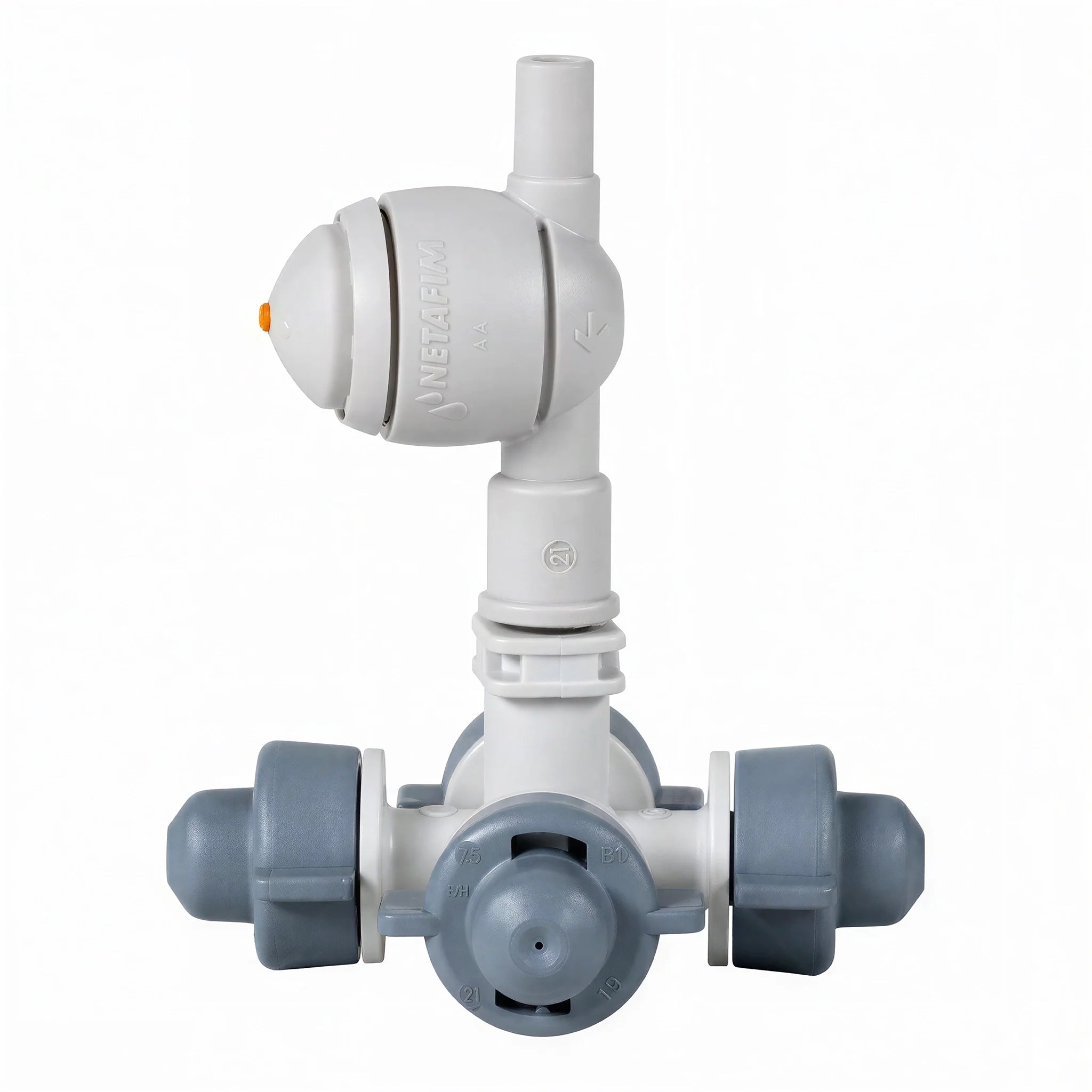
Netafim Woodpecker drip stakes deliver precise, pressure-compensating flow to individual plant sites. The Woodpecker Junior and standard Woodpecker are self-piercing stakes that insert directly into poly tubing without a separate punch or fitting -- pull-out resistance is built into the stake body. Flow rates are fixed per model (typically 0.5, 1.0, or 2.0 GPH) regardless of pressure variation between 10-50 PSI -- the pressure-compensating mechanism ensures each plant site receives identical flow regardless of where it sits in the irrigation run. This is the core operational advantage of pressure-compensating emitters in commercial irrigation: consistent delivery to every plant without pressure management across long irrigation runs.
Netafim Disc Filters & System Accessories
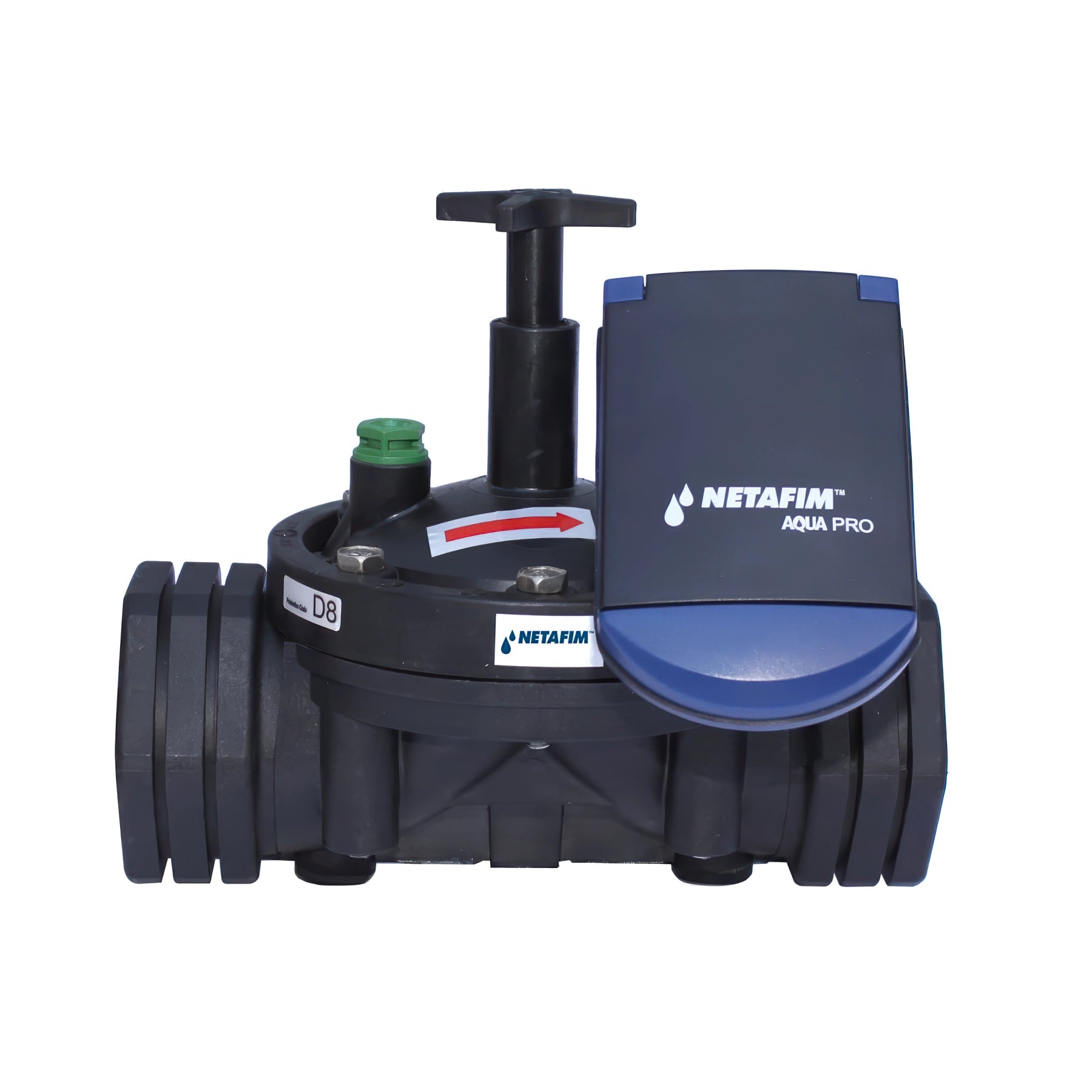
Disc filters are an essential component of any drip irrigation system -- they remove particles that would clog emitter orifices and drip stakes. Netafim disc filters use stacked polymer discs with grooves that create a helical filtration path; filtration degree (120 mesh, 155 mesh) determines the particle size the filter removes. Install a disc filter at the head of every drip irrigation system, before any emitters or drip stakes. For systems with multiple zones, install a filter on each zone inlet. Inline shut-off valves (available for 13mm, 16mm, and 3/4-inch insert sizes) allow individual plant sites or zones to be shut off for maintenance without draining the entire system. Browse our complete Netafim collection for filters, valves, tubing, fittings, and emitters. Pair with a Dosatron injector or fertigation system for fully automated nutrient delivery, and browse water filtration systems to protect emitters from sediment and mineral buildup. Expert support available.
Netafim FAQ
What is the difference between Netafim TechLock and standard insert fittings?
Standard 17mm insert fittings use a barb that pushes into the tubing ID held by friction -- maximum rated pressure 50 PSI, straightforward installation, no special tools. TechLock fittings use a compression cap and locking ring that engages the tubing OD -- rated to 100 PSI, provide 67 lb pull-out resistance, are fully reversible (can be disassembled and reconnected without replacing the fitting), and carry a 10-year subsurface warranty. For typical above-ground indoor grow room systems operating at under 30 PSI, standard insert fittings are adequate. For permanent installations, high-pressure systems, or any setup where fitting security over time is a priority, TechLock is the appropriate choice.
What size Netafim tubing do I need for a drip system?
For most indoor grow room drip irrigation systems using Netafim components, 17mm Bright White PE poly tubing (the standard mainline) is the correct starting point. This tubing has an outside diameter of approximately 0.60-0.66 inches and an inside diameter of approximately 0.56-0.60 inches -- compatible with all standard 17mm Netafim insert fittings and TechLock fittings. From the 17mm mainline, you can run 1/4-inch micro-tubing or Woodpecker drip stakes directly to plant sites. For large commercial systems with high flow demand across many plant sites, 3/4-inch or 1-inch PE poly mainline may be appropriate -- contact our expert team at 888-815-9763 to size your specific system.
What are pressure-compensating drip emitters and why do they matter?
Pressure-compensating (PC) emitters maintain a consistent flow rate (e.g., 1.0 GPH) across a range of operating pressures (typically 10-50 PSI). In a drip irrigation system without pressure compensation, plant sites at the beginning of the irrigation run (higher pressure) receive more water than sites at the end of the run (lower pressure) -- sometimes significantly more over a full grow cycle. PC emitters eliminate this variation: every plant site on the run receives the same flow regardless of its position. For commercial operations growing uniform crops, consistent water delivery across all plants is a key factor in canopy uniformity and consistent yield per plant. Netafim Woodpecker drip stakes are pressure-compensating and are the recommended choice for any system with 10+ plant sites or long irrigation runs.
Do I need a disc filter for my Netafim drip system?
Yes -- a disc filter is essential for any drip irrigation system using emitters or drip stakes. Drip emitters have small orifices (typically 0.3-0.8mm diameter) that clog with particles in unfiltered water -- sediment, mineral deposits, and organic matter. A 120-155 mesh Netafim disc filter installed at the head of the system removes particles before they reach emitters, preventing clogs that would disrupt uniform delivery and require disassembly to clear. Even with RO or filtered source water, particle contamination from nutrient mixing, reservoir algae, or root zone debris can reach irrigation lines in recirculating systems. Install a filter at the head of every zone or system, inspect it monthly, and clean it when pressure drop across the filter increases measurably.
How many drip emitters do I need per plant?
For most container-grown crops in coco coir or other well-draining media, 1-2 drip stakes or emitters per container provides adequate distribution for containers up to 5 gallons. For containers larger than 5 gallons or for rockwool slabs where uniform wetting across the full medium surface matters, 2-4 emitter sites per container/slab provides better coverage. For high-frequency irrigation programs (6-12+ irrigation events per day at low volume per event), a single drip stake per container is usually sufficient -- frequent short pulses distribute evenly through well-structured media. For low-frequency programs (1-2 irrigations per day at higher volume), 2 emitters per container improve distribution. When in doubt, more emitters producing smaller, more frequent pulses delivers better root zone uniformity than fewer emitters with larger, less frequent events.