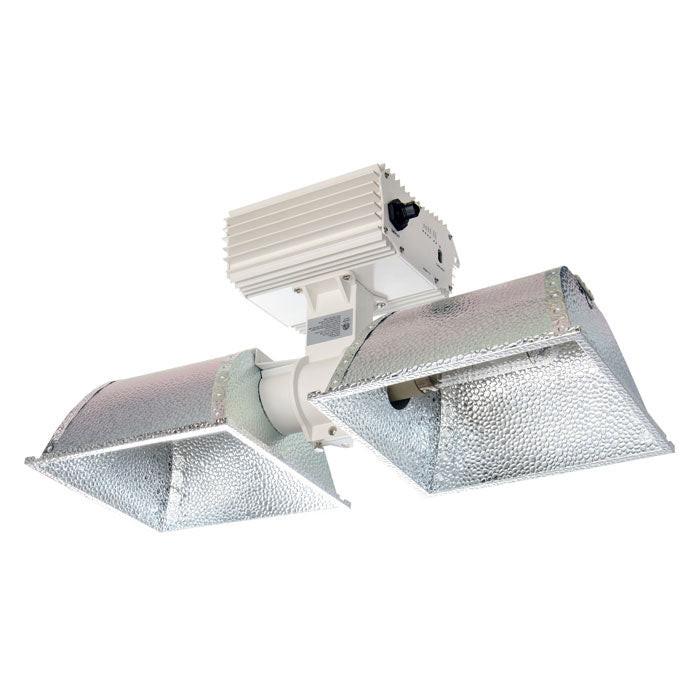
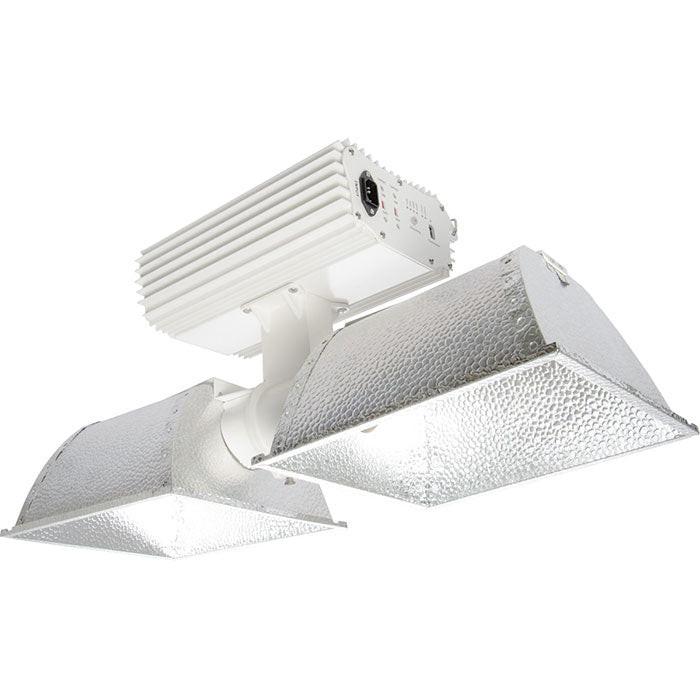
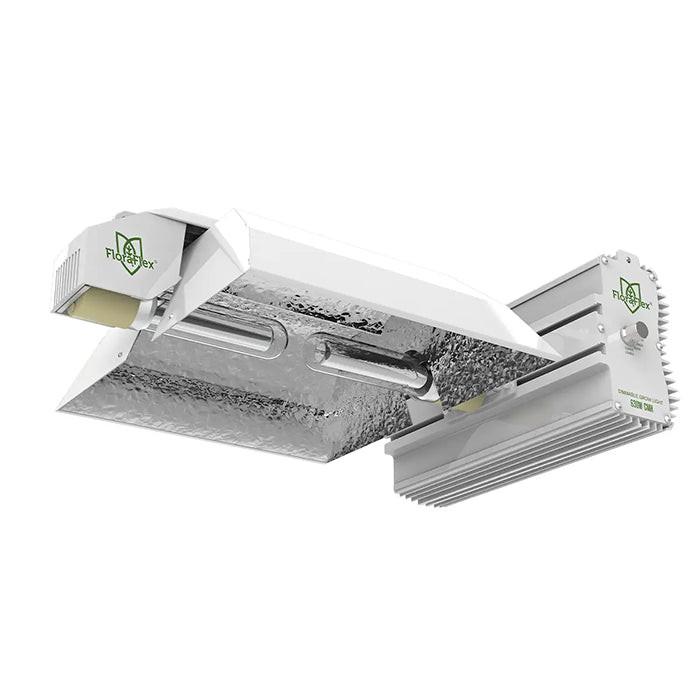
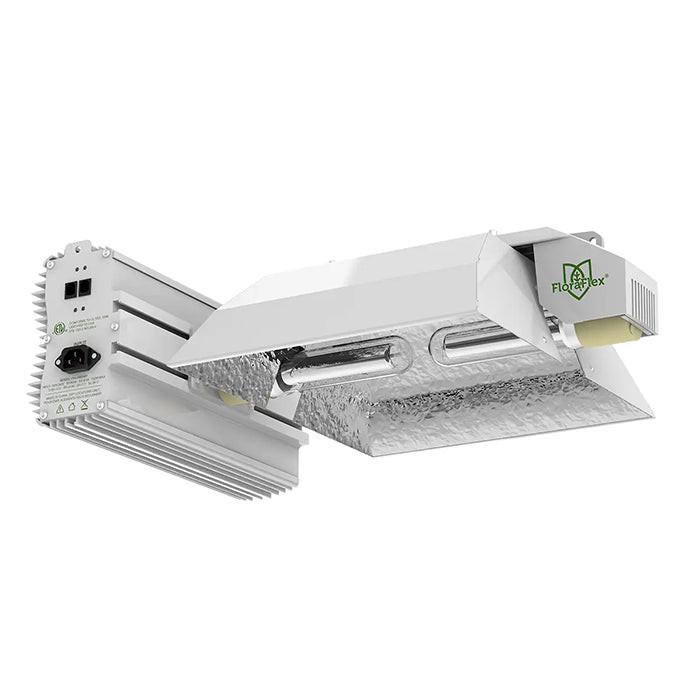
630 Watt CMH & LEC Grow Lights
The 630W CMH (ceramic metal halide) fixture is the most widely used configuration in the CMH/LEC category -- housing two 315W CMH lamps in a single ballast-and-reflector assembly to cover a 4x4 to 5x5 ft canopy footprint. The dual 315W configuration delivers 630W total output -- more than twice the output of a single 315W CMH -- with the full-spectrum, high-CRI light quality that CMH is known for: a broad continuous spectrum from 380-780nm that closely mimics natural sunlight, with strong UV and far-red output that most LED and HPS fixtures lack. For growers who prioritize spectrum quality and natural-looking light for visual assessment of plant health, 630W CMH remains a compelling option alongside modern LED alternatives.
CMH Spectrum vs. HPS and LED
The CMH lamp's ceramic burner produces a continuous spectrum with a Color Rendering Index (CRI) of 90+ -- dramatically higher than HPS (CRI ~25) and roughly comparable to or slightly better than most full-spectrum LED arrays. The practical benefits of this higher CRI are: better visual assessment of plant health (colors appear more natural under CMH; under HPS the pink-orange cast makes leaf color diagnosis difficult), meaningful UV output in the 315-400nm range that can influence terpene and secondary metabolite production in some crops, and strong far-red output that activates the phytochrome system for specific morphological effects. CMH runs at approximately 1.9-2.0 umol/joule efficiency -- less efficient than modern LED at 2.7-3.0 umol/joule but meaningfully better than DE HPS. Browse the full CMH grow lights collection for 315W single-lamp options alongside 630W fixtures.
630W CMH Coverage & Placement
A 630W fixture covers a 4x4 ft footprint effectively at 24-30 inch hanging height for most flowering programs, delivering approximately 700-900 umol/m2/s PPFD at canopy center. At 5x5 ft coverage, PPFD drops to 500-650 umol/m2/s -- adequate for vegetative production and lower-intensity crops. Lamp options: 3100K lamps provide a warm spectrum for flowering; 4200K lamps provide a cooler spectrum optimized for vegetative growth; some growers run mixed lamp temperatures in the dual-lamp fixture. Replacement lamp cycle: CMH lamps maintain output better than HPS (approximately 90% output at 10,000 hours vs. 70-75% for HPS), but annual replacement in commercial operations is standard practice. Expert support available.
630 Watt CMH Grow Lights FAQ
Is 630W CMH better than LED for growing?
Modern LED at 2.7-3.0 umol/joule is more efficient than 630W CMH at 1.9-2.0 umol/joule -- delivering 35-50% more photons per watt of electricity. For growers whose primary priority is yield per electricity dollar, a quality 630W LED bar array outperforms 630W CMH on efficiency. CMH makes a strong case when spectrum quality is the priority: its full continuous spectrum with 90+ CRI, meaningful UV output, and natural color rendering are genuine advantages for growers who value spectrum completeness. In practice, both produce excellent crops -- the choice depends on whether efficiency savings or spectrum quality is the more important factor for your operation.
What is the difference between CMH and LEC grow lights?
CMH (ceramic metal halide) and LEC (light emitting ceramic) refer to the same lamp technology -- the ceramic burner construction that distinguishes these fixtures from standard quartz metal halide. "LEC" is a marketing term popularized by California Lightworks for their CMH fixtures; both terms describe the same ceramic-arc tube lamp technology. All 315W and 630W "LEC" fixtures use CMH lamp technology. When comparing fixtures across brands, focus on the lamp specifications (wattage, color temperature, CRI, lamp brand) rather than whether the fixture is marketed as CMH or LEC.
How often should I replace 630W CMH lamps?
CMH lamps maintain output better than HPS -- approximately 90% of initial output at 10,000 hours versus 70-75% for HPS. At 16-18 hours per day in a production environment, 10,000 hours is roughly 1.5-2 years of operation. For commercial operations where consistent output is a quality standard, annual lamp replacement at peak season end is common practice. For hobby growers, biennial replacement is adequate unless output visibly declines. Always replace both lamps in a dual-lamp 630W fixture at the same time -- mismatched lamp ages produce uneven PPFD distribution across the canopy footprint.
What ballast is needed for a 630W CMH fixture?
CMH lamps require a compatible CMH/LEC ballast -- they cannot be run on standard MH or HPS ballasts. Most 630W CMH fixtures come as complete units with a matched ballast included. Replacement or separate ballasts must be specified for CMH operation at the correct wattage (315W per lamp, 630W total for dual-lamp operation). Some advanced CMH ballasts include 0-10V dimming capability -- useful for controller integration, though full dimming compatibility requires a controller with analog dimming output.
Does CMH produce UV light that benefits plants?
Yes -- CMH lamps produce meaningful UV-A (315-400nm) output, unlike HPS which produces virtually none and most LED arrays which produce limited UV. UV-A exposure in plants has documented effects on the production of secondary metabolites -- flavonoids, anthocyanins, and other UV-absorbing compounds that plants produce in response to UV stress. In some specialty and herb crops, UV exposure during the final weeks before harvest has been associated with increased terpene and aromatic compound production. The effect is crop and variety dependent -- some crops show clear UV response; others show minimal difference. CMH's UV output is one of the most commonly cited reasons growers choose it over HPS for quality-focused production.