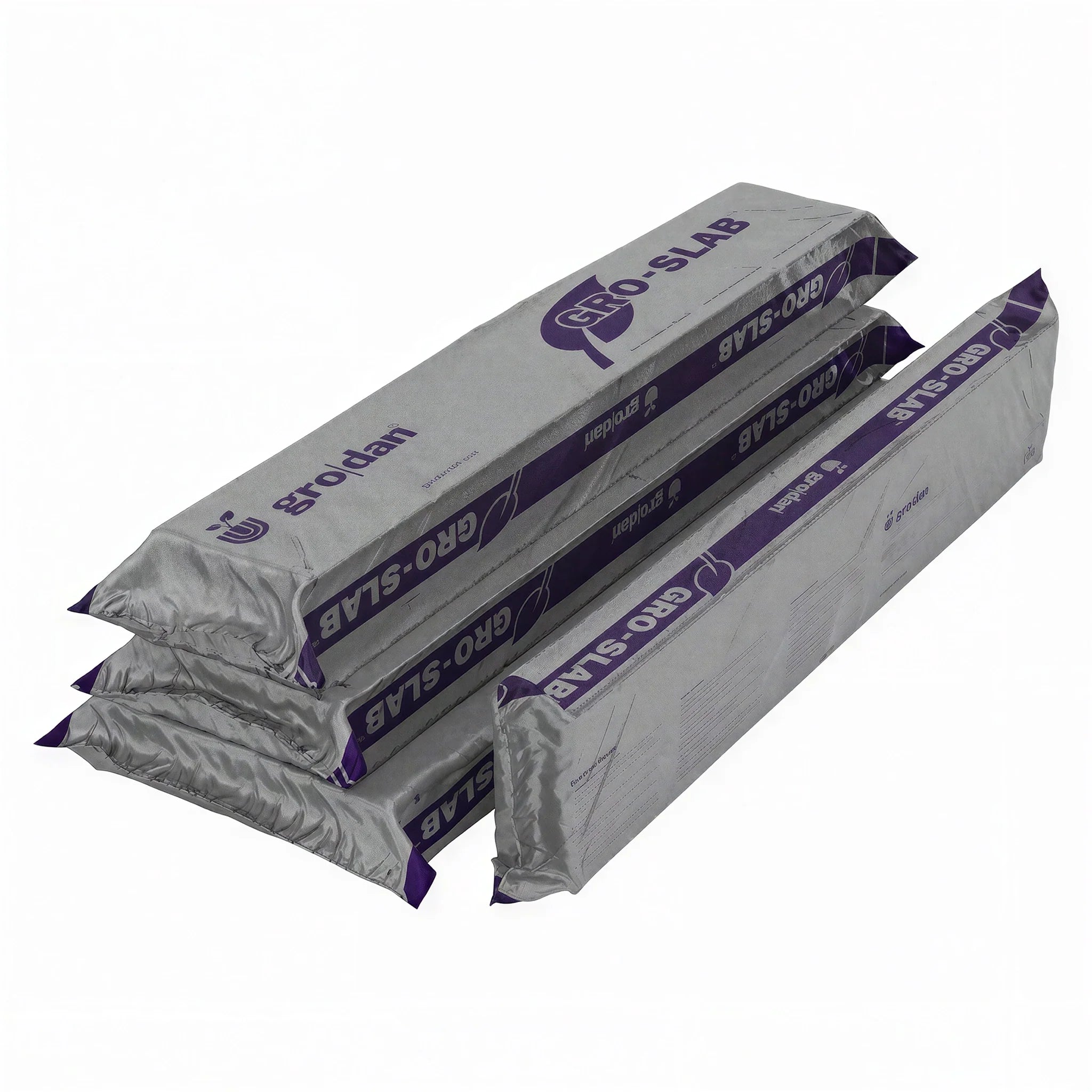
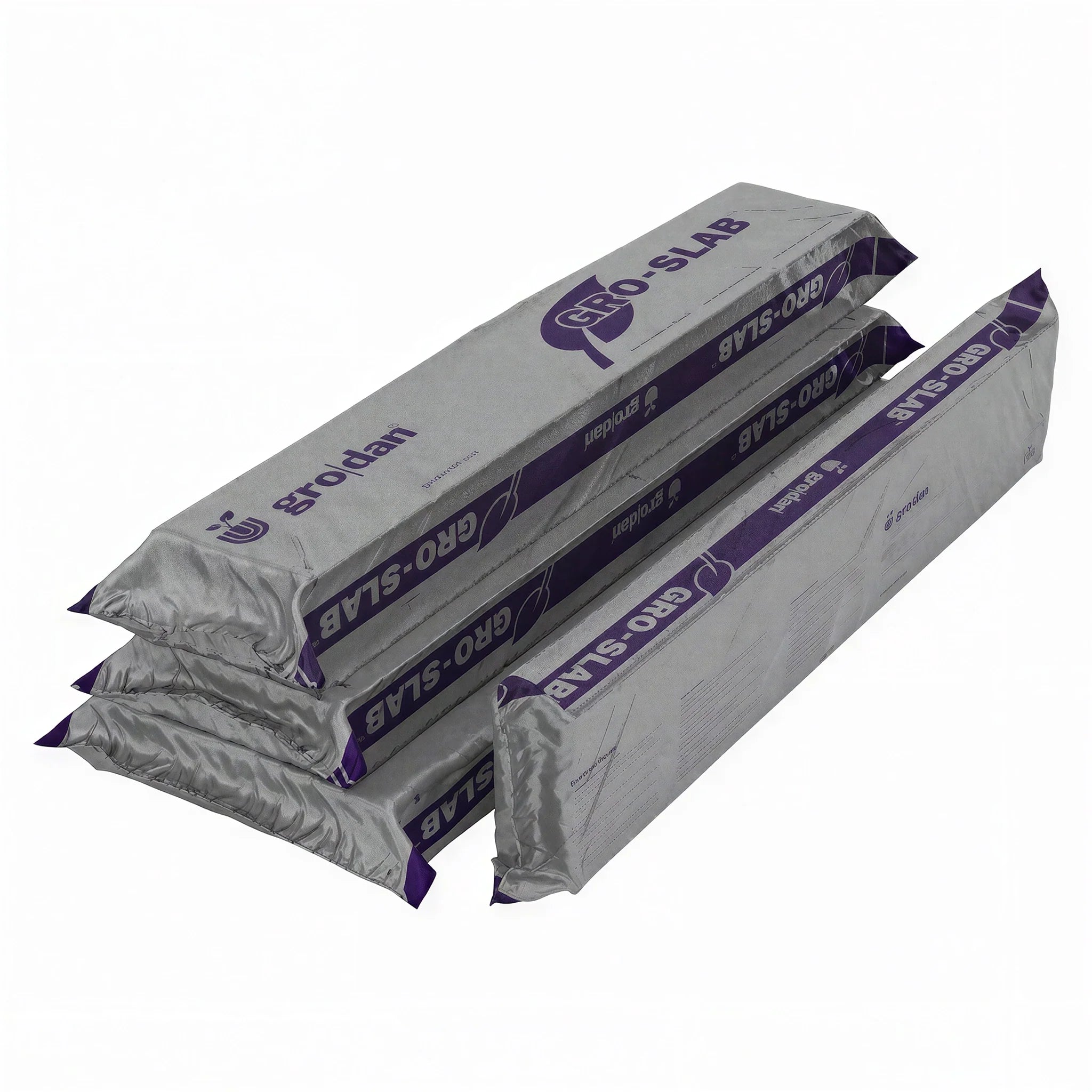
Rockwool Grow Slabs for Commercial Hydroponic Production
Rockwool grow slabs are the production-stage substrate for commercial long-cycle hydroponic crops -- tomatoes, cucumbers, peppers, eggplant, and similar high-value fruiting vegetables grown in drip-irrigated greenhouse systems. A standard rockwool slab (typically 6-inch x 36-inch or 8-inch x 36-inch, 3-4 inches thick) supports one to four plants depending on crop spacing, receiving drip emitters at each plant site and draining to a collection channel or tray. The slab format provides a defined, consistent substrate volume per plant that enables precise irrigation management -- the heart of commercial rockwool production programs.
Grodan vs. VidaWool Slabs
Grodan is the Dutch-manufactured benchmark for commercial rockwool slabs, with the most extensive published performance data and the widest adoption in commercial greenhouse production globally. VidaWool is the US-manufactured alternative with comparable horticultural specifications and domestic supply chain advantages. For commercial operations building on established Grodan irrigation parameters, switching to VidaWool slabs requires validating that irrigation program parameters produce the same water content and dry-back behavior. Browse our VidaWool collection and all rockwool collection for the full range.
Slab Preparation & Irrigation Setup
New rockwool slabs require pre-saturation before planting -- soak at pH 5.5 for 1-2 hours to buffer the alkaline mineral binder chemistry to plant-safe pH. Install drip emitters at each plant site for even distribution across the slab width. Commercial slab programs use VWC sensors embedded in the slab center for continuous moisture monitoring to execute dry-back targets. Expert support available.
Rockwool Grow Slabs FAQ
What are rockwool grow slabs used for?
Rockwool grow slabs are the production substrate for commercial long-cycle hydroponic crops -- primarily fruiting vegetables like tomatoes, cucumbers, and peppers grown in drip-irrigated greenhouse systems. The slab format provides a standardized substrate volume per plant that enables the precise irrigation and dry-back management used in commercial crop steering programs. They are not typically used for short-cycle crops like lettuce or herbs -- those crops use propagation cubes or NFT channels rather than slabs.
How do I set up rockwool slabs for tomatoes or cucumbers?
Lay pre-soaked slabs on a level collection tray or channel on your growing bench. Make a small drainage slit on the underside of each slab at the lowest point to allow excess water to drain. Transplant rooted rockwool cubes (3-inch or 4-inch transplant blocks) onto the slab surface, pressing down slightly to ensure contact. Install drip emitters at each plant site. Begin with small frequent irrigation events and monitor slab VWC with an embedded sensor to establish the irrigation frequency that maintains target water content.
How long does a rockwool slab last?
Rockwool slabs are typically used for one production season in commercial fruiting vegetable programs, then replaced. The physical rockwool fibers degrade minimally over a single crop cycle, but root system colonization, salt accumulation, and potential pathogen carryover make reuse for a second full crop cycle risky in high-value commercial operations. Some growers steam-sterilize slabs between crop cycles for reuse -- acceptable where pathogen pressure has been low and the cost of sterilization is less than replacement slab cost.
What drainage rate should I expect from rockwool slabs?
Commercial rockwool slabs are engineered for approximately 15-25% runoff per irrigation event at full production -- meaning 15-25% of the water delivered drains out of the slab. This runoff rate is intentional: it prevents salt accumulation in the slab, flushes the root zone, and provides the measurable runoff EC data used to monitor plant uptake. In well-managed programs, runoff EC is monitored daily and irrigation EC is adjusted based on the difference between delivered and runoff EC.
Can I use rockwool slabs for crops other than tomatoes and cucumbers?
Yes -- rockwool slabs are used for a wide range of long-cycle crops including peppers, eggplant, cut-flower crops, and other high-value fruiting and flowering varieties in commercial greenhouse production. The same slab format and drip irrigation approach applies across all these crops; the differences are in irrigation frequency, nutrient program, and dry-back targets suited to each specific crop type. For hobby growers, smaller rockwool blocks (4-inch and 6-inch cube formats) are more practical than full commercial slabs for single-plant or small-scale applications.