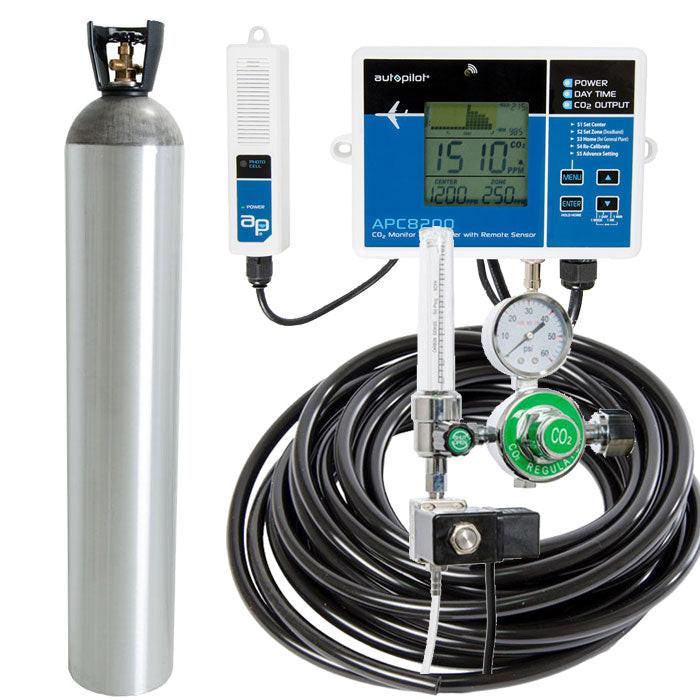
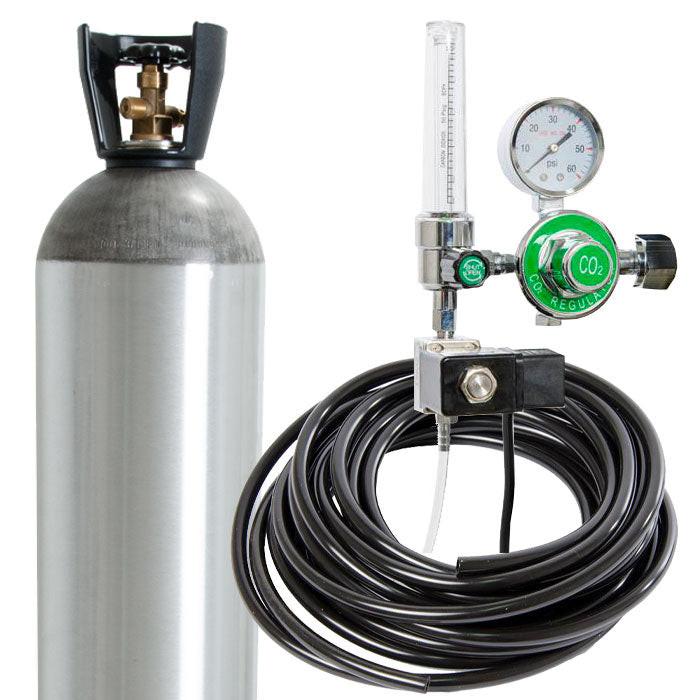
CO2 Tank & Regulator Kits for Grow Rooms
CO2 tank and regulator systems are the most precise method for delivering supplemental CO2 to sealed grow rooms and grow tents. A compressed CO2 cylinder (typically 5-50 lbs) connects to a regulator that controls release pressure and flow rate; a solenoid valve opens and closes on command from a CO2 controller; and a timer or PPM controller maintains target CO2 concentration by opening the solenoid at intervals to add CO2 as plants consume it. Tank systems deliver CO2 immediately on demand, produce no heat, require no combustion, and are well-suited to sealed environments where temperature management is already challenging without adding a CO2 burner's heat load.
CO2 Tank Systems vs. CO2 Burners
The two primary CO2 enrichment methods for grow rooms are tank-and-regulator systems and CO2 burners (natural gas or propane). Tank systems: precise, clean CO2 delivery with no combustion byproducts, no heat, and immediate on/off control via solenoid. Best for sealed or small rooms where heat and water vapor from combustion would be problematic. Tanks require refilling (typical refill interval: a 20 lb tank lasts 1-4 weeks depending on room size and CO2 targets). CO2 burners: produce CO2 through combustion, generating heat and water vapor as byproducts -- the heat can be used to offset cooling costs in winter in cold climates, but adds to cooling load in warm climates or summer operation. Burners are cost-effective at large scale where tank refill costs become significant. For hobby grows and small commercial rooms, tank systems are the standard recommendation due to their simplicity, cleanliness, and compatibility with sealed environment management. Use our CO2 Calculator to size your tank system for your room volume and target CO2 PPM.
CO2 Regulators, Solenoids & Controllers
A complete tank CO2 system requires: a CO2 cylinder, a regulator (reduces tank pressure to a controlled low-pressure output), a solenoid valve (electrically operated on/off valve), and a CO2 controller or timer. The regulator and solenoid are often sold as a combined unit -- the regulator sets flow rate, the solenoid controls when CO2 flows. Controllers range from simple photocell-based timers (open the solenoid for a set duration at intervals during the photoperiod only) to precision infrared CO2 PPM sensors that open the solenoid when CO2 drops below setpoint and close it when target is reached. For most growers, an infrared PPM controller provides the most efficient CO2 use -- only adding CO2 when needed rather than on a fixed timer schedule that may over- or under-enrich based on varying plant consumption rates. Browse our complete CO2 systems collection for regulators, controllers, and complete kits, and our environment controllers for multi-function systems that integrate CO2 management alongside temperature and humidity. Fast shipping.
CO2 Tank & Regulator Kits FAQ
How much CO2 does a grow room need?
Ambient outdoor CO2 is approximately 400-420 PPM. For sealed grow rooms with adequate light intensity (above 600-800 umol/m2/s PPFD), enriching to 1,000-1,500 PPM drives measurably higher photosynthesis rates. Above 1,500 PPM provides diminishing returns for most crops and can cause stress at very high concentrations. CO2 enrichment only benefits grows where light is NOT the limiting factor -- if your PPFD is below 600 umol/m2/s, address lighting before investing in CO2. Use our CO2 Calculator to model enrichment rates and tank consumption for your specific room volume and target PPM.
How long does a CO2 tank last in a grow room?
Tank consumption depends on room volume, target CO2 PPM, how sealed the environment is, plant uptake rate, and CO2 dosing method. Very rough estimates for a 4x4 tent enriched to 1,200 PPM: a 5 lb CO2 tank lasts approximately 1-2 weeks with a PPM controller; a 20 lb tank lasts 4-8 weeks. Larger rooms with more volume to enrich and more plant biomass consuming CO2 go through tanks faster. PPM controllers are significantly more efficient than timer-based dosing because they only add CO2 when the PPM drops below setpoint rather than pulsing on a fixed schedule regardless of current CO2 level. For rooms with high air exchange rates (non-sealed), maintaining CO2 enrichment requires continuous CO2 delivery and accelerated tank consumption -- CO2 enrichment is most efficient in tightly sealed rooms with minimal air exchange.
Do I need to run CO2 during the dark period?
No -- CO2 enrichment is only effective during the photoperiod when plants are actively photosynthesizing. Releasing CO2 during the dark period wastes it entirely, as plants switch from photosynthesis to respiration at lights-off and cannot use elevated CO2. Most CO2 regulators include a photocell or can be connected to a lighting controller to automatically close the solenoid during the dark period. TrolMaster Hydro-X can automate CO2 control through its photoperiod-aware scheduling -- opening the CO2 solenoid only during the light period. This is one of the most impactful efficiency steps for tank CO2 systems: eliminating dark-period CO2 release can cut tank consumption by 30-50% depending on your light schedule.
What is the difference between a CO2 regulator and a CO2 controller?
A CO2 regulator is a mechanical device that connects to the CO2 tank and reduces the high-pressure tank output to a controlled low-pressure flow rate -- it does not monitor or respond to CO2 levels in the room. A CO2 controller monitors actual CO2 concentration in the room (using an infrared CO2 sensor) and opens or closes the solenoid to maintain your target PPM setpoint. Basic timer-based CO2 systems use a regulator plus a photocell timer -- simple and inexpensive, but not responsive to actual room CO2 levels. PPM controller systems use a regulator plus an infrared sensor controller -- more efficient CO2 use, more consistent PPM maintenance, and more accurate representation of actual plant CO2 consumption. For serious grows targeting consistent 1,000-1,500 PPM enrichment, a PPM controller is worth the additional investment over timer-based dosing.