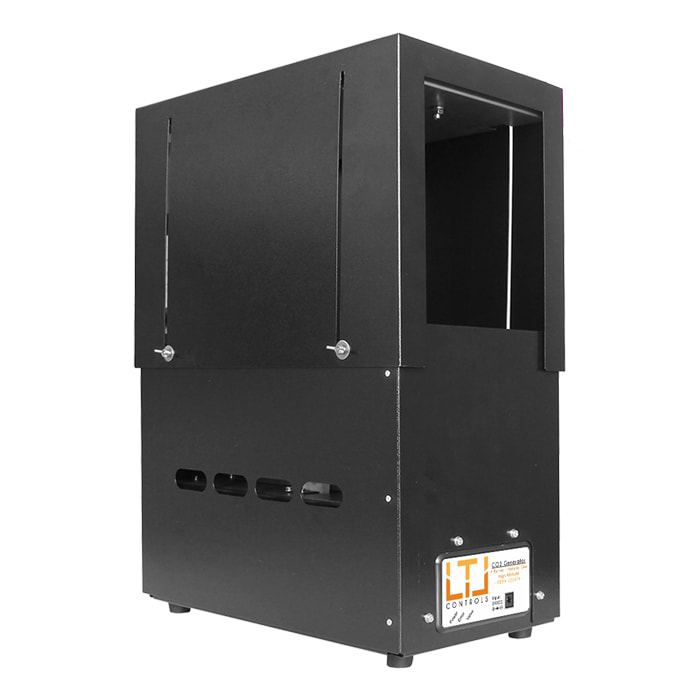
CO2 Burners & Generators for Grow Rooms
CO2 burners (also called CO2 generators) produce carbon dioxide through the combustion of natural gas or propane, raising CO2 concentration in the grow room to support enhanced photosynthesis. Unlike compressed tank systems that release pre-stored CO2, burners generate CO2 in real time through an ongoing combustion process -- burning fuel to produce CO2, water vapor, and heat as combustion byproducts. At commercial scale where tank refill logistics and cost become significant, burners provide a more economical continuous CO2 source at the cost of managing heat and water vapor alongside the CO2 output.
CO2 Burners vs. CO2 Tank Systems
Tank systems deliver clean, cold CO2 with no combustion byproducts and are easily controlled by a solenoid valve and PPM controller. They are ideal for sealed or small rooms where additional heat and water vapor from combustion would create climate management challenges. CO2 burners produce significant heat (each BTU of combustion adds to your cooling load) and water vapor (combustion of natural gas produces approximately 1 liter of water per cubic foot of gas burned) alongside the CO2 output -- these byproducts require active HVAC management and make burners unsuitable for rooms without robust air conditioning and dehumidification. The economics favor burners at commercial scale (multiple large rooms, high continuous CO2 demand) where natural gas or propane is significantly cheaper per unit of CO2 than tank refills. Use our CO2 Calculator to compare operating costs for your specific setup.
Natural Gas vs. Propane CO2 Generators
CO2 generators are available for natural gas (piped supply -- no tank required) and propane (bottled supply). Natural gas burners are the preferred choice for permanent commercial installations with existing natural gas infrastructure -- no tank logistics, continuous supply, and typically the lowest cost per unit of CO2 at scale. Propane burners are more portable and practical for facilities without natural gas access. Both produce the same CO2 output per BTU of fuel; propane contains more BTUs per cubic foot and produces proportionally more CO2 per unit volume. Pair with a dedicated CO2 PPM controller and IR sensor for automated PPM management. Expert support available.
CO2 Burners & Generators FAQ
Are CO2 burners safe for indoor growing?
CO2 generators are safe when properly installed with adequate ventilation and CO2 monitoring. Key safety requirements: a dedicated CO2 PPM controller that shuts off the burner if CO2 exceeds safe human exposure levels (OSHA limits: 5,000 ppm for 8-hour exposure; immediately dangerous above 40,000 ppm), adequate room ventilation to prevent CO2 and combustion product accumulation, proper combustion air supply for the burner, and gas line connections inspected for leaks before each season. Never run CO2 generators in occupied spaces without proper monitoring. In the event of a controller failure, CO2 can build to dangerous concentrations rapidly in a sealed grow room.
Can I use a CO2 burner in a grow tent?
No -- CO2 burners are not suitable for grow tents. The heat and water vapor from combustion in a sealed tent environment are unmanageable without commercial-grade HVAC, and the combustion air requirement cannot be safely met in a sealed tent. CO2 burners are for dedicated, well-ventilated grow rooms with robust air conditioning and dehumidification infrastructure. For grow tents, compressed CO2 tank systems with a regulator and solenoid valve are the appropriate CO2 source -- clean, no heat, no combustion products, and easily controlled by a PPM controller or timer.
How do I size a CO2 burner for my grow room?
CO2 burner output is rated in BTU/hr, which translates to a specific cubic feet per hour (CFH) of CO2 produced. To maintain 1,200-1,500 PPM CO2 in a sealed room, you need to replace CO2 consumed by plants plus compensate for any air exchange. A starting rule: approximately 1 CFH of CO2 per 1,000 cubic feet of room volume for a well-sealed room at moderate plant density. Use our CO2 Calculator to model specific enrichment rates and burner sizing for your room dimensions, plant count, and target PPM -- and always pair with an IR PPM controller that shuts the burner off when target CO2 is reached.
Does a CO2 burner add heat to my grow room?
Yes -- significantly. Natural gas combustion produces approximately 1,000 BTU of heat per 100 ppm of CO2 added per 1,000 cubic feet of room space, as a rough reference. In a well-insulated sealed grow room, this heat load is additive to your lighting heat load and must be handled by your air conditioning system. Factor CO2 burner heat output into your total room BTU calculation when sizing AC. This is one of the primary reasons tank CO2 is preferred in smaller or less well-air-conditioned grow rooms -- tank CO2 adds no heat, while burners can add as much heat as a supplemental heating unit.
Do CO2 burners require a pilot light or electronic ignition?
Modern CO2 generators use electronic ignition -- a spark ignition system that lights the burner only when the CO2 controller or timer calls for CO2, eliminating the standing pilot light and its continuous fuel consumption. Standing pilot configurations are found on older units and some lower-cost models. For grow rooms where the burner cycles on and off under PPM controller management (which is the correct operation), electronic ignition is strongly preferred -- it eliminates the small but continuous CO2 output and heat from a standing pilot, reduces fuel consumption, and removes the risk of the pilot being extinguished by air movement without triggering a safety shutoff.