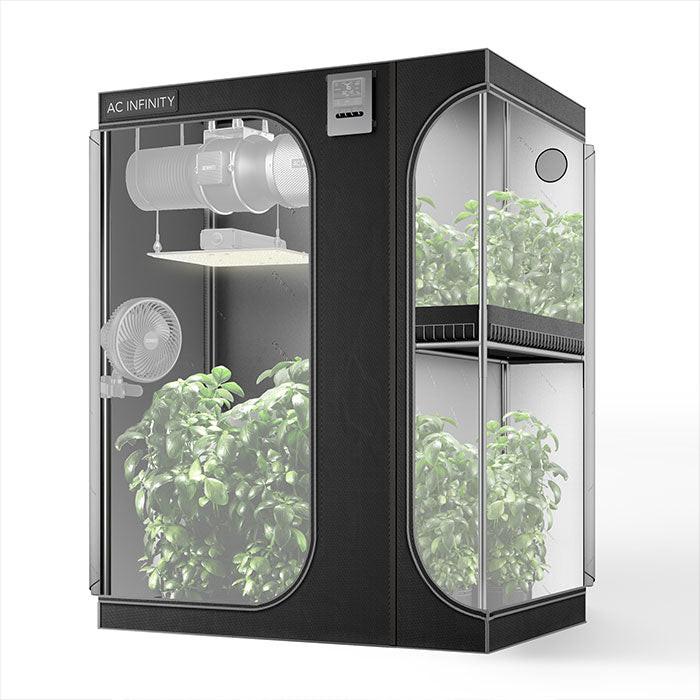
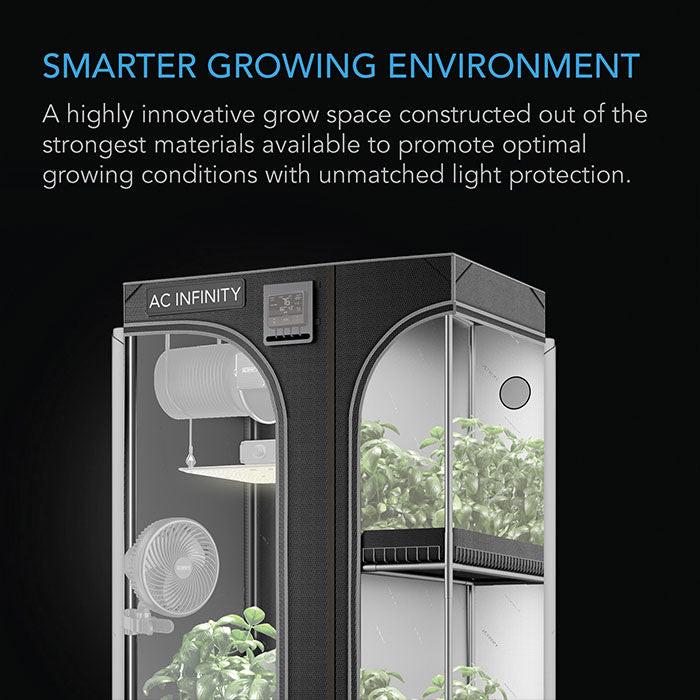
4x5 Grow Tents for Indoor Growing
The 4x5 ft grow tent (48x60 inches) provides 20 sq ft of canopy in an asymmetric format slightly larger than a 4x4 ft -- a useful option when a standard 4x4 ft tent leaves too little space and a 4x8 ft is more than needed. The extra foot of length compared to a 4x4 accommodates a more compact ebb and flow tray, an extra row of containers, or slightly more canopy development room for plants trained horizontally across the tray. For dedicated rooms where 60 inches of length is available, the 4x5 uses floor space more efficiently than a 4x4 tent with 12 inches of unused room depth.
What Fits in a 4x5 Tent
The 20 sq ft canopy area fits: 6-9 plants in 3-gallon containers with standard spacing; 4-6 plants in 5-gallon containers; a 4x5 flood table for ebb and flow operation; or a SCROG net trained to fill the full 4x5 footprint from 3-5 plants. A single 600-750W LED bar array rated for 4x5 or 5x5 ft coverage provides adequate PPFD across the 20 sq ft canopy. Ventilation: a 4-inch inline fan at 200-250 CFM covers the approximately 720 cubic feet at standard 6-foot ceiling height. Browse the full grow tents collection for all available sizes.
4x5 vs. 5x5 Tents
A 5x5 ft tent provides 25 sq ft versus 20 sq ft for the 4x5, and the square footprint of a 5x5 allows more uniform single-fixture coverage than the rectangular 4x5. If your room can accommodate the 5x5 footprint (60x60 inches), the 5x5 is generally the better choice for equipment availability and coverage uniformity. The 4x5 makes the most sense when room depth is limited to 4 feet but length extends beyond 4 feet -- making the extra 12 inches of length more useful than the 12 inches of width a 5x5 would require. Fast shipping.
4x5 Grow Tents FAQ
What is a 4x5 grow tent?
A 4x5 ft grow tent has a 48x60 inch floor footprint providing 20 sq ft of canopy area. It sits between the standard 4x4 ft (16 sq ft) and 4x8 ft (32 sq ft) sizes, and is less common than either standard format. The 4x5 is most useful in rooms where 4 feet of depth and 5 feet of length are available -- the extra foot over a 4x4 provides meaningful additional canopy space without requiring the full 8-foot length of a 4x8.
What light do I need for a 4x5 grow tent?
A single 600-750W LED bar array rated for 4x5 or 5x5 ft coverage provides adequate PPFD for the 20 sq ft canopy. Most commercial LED bars designed for 5x5 ft coverage will cover 4x5 ft at slightly higher intensity at standard hanging heights. Verify the fixture's PPFD map covers the 48x60 inch footprint adequately at your intended hanging height -- do not rely solely on the manufacturer's square-foot coverage rating without confirming with the PPFD map.
How many plants can I grow in a 4x5 tent?
A 4x5 ft tent (20 sq ft) accommodates: 6-9 plants in 3-gallon containers with standard canopy spacing; 4-6 plants in 5-gallon containers; 15-20 plants in a sea-of-green program with 1-gallon containers. For SCROG training, 3-5 plants can fill the 4x5 canopy footprint with full horizontal training. The extra foot of length compared to a 4x4 tent adds room for one additional column of containers.
Is the 4x5 a standard tent size?
The 4x5 ft format is less common than 4x4, 4x8, and 5x5, but is produced by some manufacturers including Gorilla Grow Tent. Accessory availability (purpose-sized trellis nets, matched tray sizes) may be more limited than for the most common tent sizes. Before committing to a 4x5 tent layout, verify that compatible flood tables, trellis nets, and other sized accessories are available for the 48x60 inch footprint.
Should I get a 4x5 or 5x5 tent?
If your room can fit 60x60 inches, the 5x5 is generally the better choice -- the square footprint provides more uniform single-fixture coverage, more equipment and accessory options, and 25% more canopy area (25 sq ft vs. 20 sq ft). Choose the 4x5 when: your room depth is constrained to 4 feet (making 60-inch depth of a 5x5 impractical) while having 5+ feet of available length; or when you specifically want the rectangular footprint for a row-based container layout.