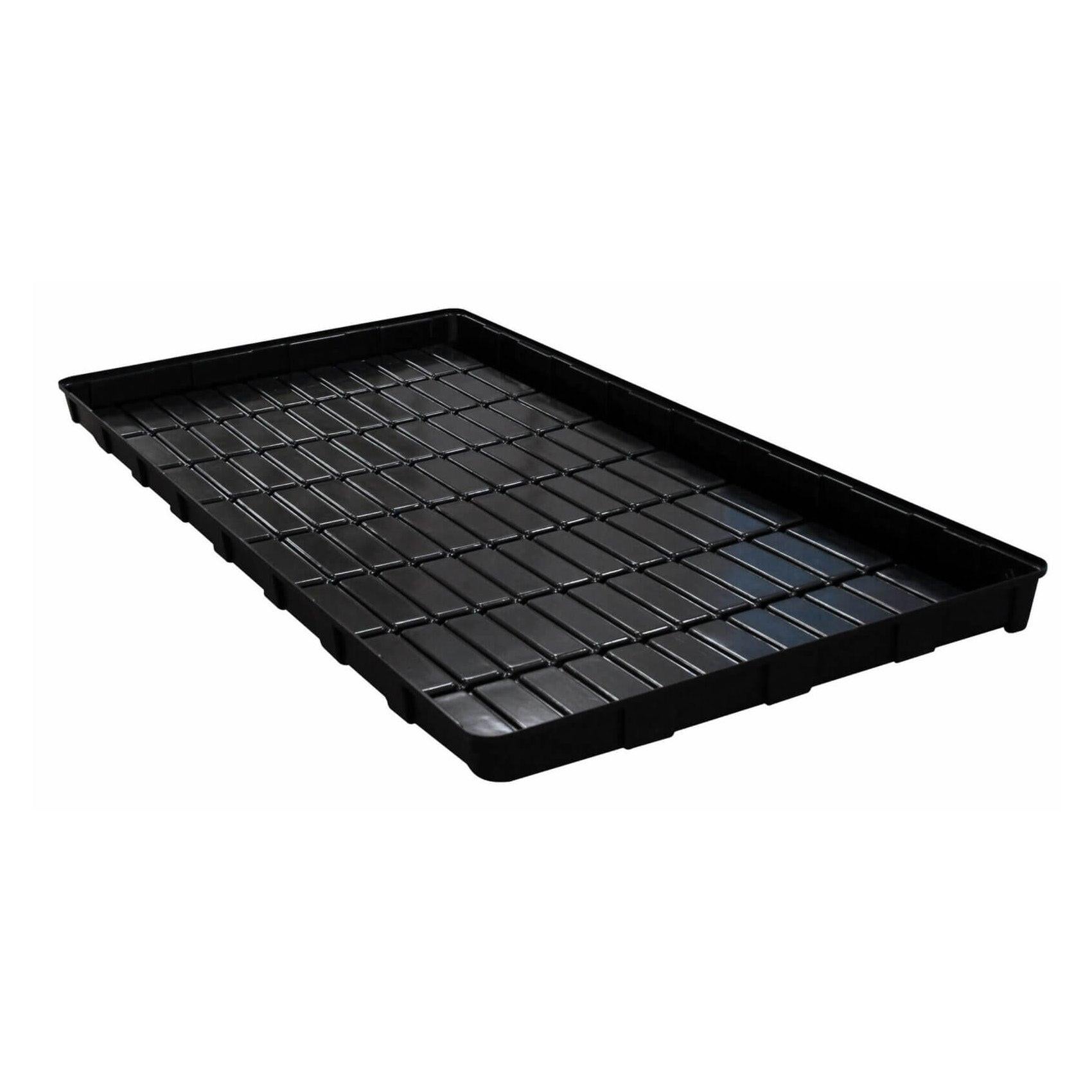
4x8 Grow Trays & Flood Tables for Ebb & Flow Systems
4x8 foot grow trays and flood tables are the workhorse format of commercial hydroponic ebb and flow production -- providing 32 square feet of growing surface that accommodates 16-24 standard containers, 2-4 rows of coco or rockwool slab production, or dense spacing of propagation trays and clone flats. The 4x8 ft footprint aligns with standard building dimensions, fits under two 600-1,000W HPS fixtures or two 500-900W LED bars, and stacks efficiently on multi-tier benching systems in greenhouse and warehouse growing operations.
Construction & Drain Options
Commercial 4x8 flood tables are manufactured from high-density polyethylene (HDPE) or ABS plastic with reinforced ribs on the underside that provide structural support across the 32 sq ft span without requiring a continuous solid table surface below -- the ribbed understructure allows the tray to span standard grow tent floor or table leg spacing. Standard drain configurations: center drain (single drain fitting centered in the tray -- simplest plumbing, adequate for most flat-surface ebb and flow setups); corner drain (drain in one corner with the opposite corner slightly elevated -- drains completely without any pooling at the center); and multi-drain (multiple 3/4-inch or 1-inch drain fittings along the tray length -- used in commercial applications where fast drainage of large water volumes is important). Browse our complete grow trays and flood tables collection for all sizes and our ebb and flow systems collection for complete system components.
Table Height & Stand Options
4x8 trays are used at floor level (for low-profile greenhouse bench setups) or elevated on tray stands and bench legs at 24-36 inch working height. Adjustable-height stands allow customizing working height for ergonomic access and for matching the tray height to flood reservoir placement below. Fast shipping.
4x8 Grow Trays FAQ
What can I grow in a 4x8 flood table?
A 4x8 ft flood table supports a wide range of ebb and flow production formats: 16-24 standard 5-gallon containers in a single layer; 3-4 rows of 1-gallon pots for high-density propagation; 2 rows of 1-meter coco or rockwool slabs for high-wire tomato or cucumber production; or a full flat of 72-cell propagation trays for seedling production. The container format, spacing, and plant count depend on the crop, growth stage, and production system -- the tray itself is format-agnostic.
How do I plumb a 4x8 flood table for ebb and flow?
Standard ebb and flow plumbing for a 4x8 tray: one flood fitting (typically 1-inch fitting on one side of the tray) and one overflow/drain fitting (set at the target flood depth, typically 1-2 inches above the tray floor, on the same or opposite side). The flood fitting connects to the submersible pump in the reservoir below via flexible tubing; the overflow/drain fitting returns water to the reservoir. A timer cycles the pump on for 15-30 minutes (sufficient to flood the tray to overflow height and allow substrate uptake) then off; gravity drains the tray back to the reservoir over 15-30 minutes. The reservoir must hold enough volume to flood the tray without running dry -- a 4x8 tray at 1-inch flood depth contains approximately 20 gallons.
How much water does a 4x8 flood table hold?
At 1-inch flood depth: approximately 20 gallons (32 sq ft x 0.083 ft depth x 7.48 gal/cu ft). At 2-inch flood depth: approximately 40 gallons. The practical flood depth is determined by the container or substrate height in the tray -- flood just enough to saturate the bottom of the containers and allow capillary uptake into the substrate. Size the reservoir to hold at least 1.5x the flood volume to allow the pump to flood the tray completely without the reservoir running dry.
Can I use a 4x8 flood table for drain-to-waste drip irrigation?
Yes -- 4x8 flood tables work equally well as drain-to-waste collection trays for drip irrigation systems. In this application the tray is not flooded -- drip emitters deliver nutrient solution to individual containers, and runoff drains through the tray drain fitting to a collection point or directly to drain. The tray slope (slightly toward the drain fitting) should be verified before setting up drip-to-drain production to ensure complete drainage without standing water around container bases.
What is the difference between ABS and polyethylene flood tables?
ABS (Acrylonitrile Butadiene Styrene) flood tables are rigid, have good impact resistance, and are dimensionally stable -- they maintain their flat profile under load without sagging. Polyethylene (PE or HDPE) flood tables are lighter and more flexible, resist UV degradation better for outdoor or greenhouse use, and are generally less expensive. Both materials are chemically inert to nutrient solution. For indoor production on solid benching surfaces: either material works well. For elevated setups spanning wide leg spacings where the tray must support significant container weight without sagging: thicker ABS or reinforced PE provides better structural performance.